


 Autocar
 'Baby' Defender Sport to have true "go-anywhere capability"
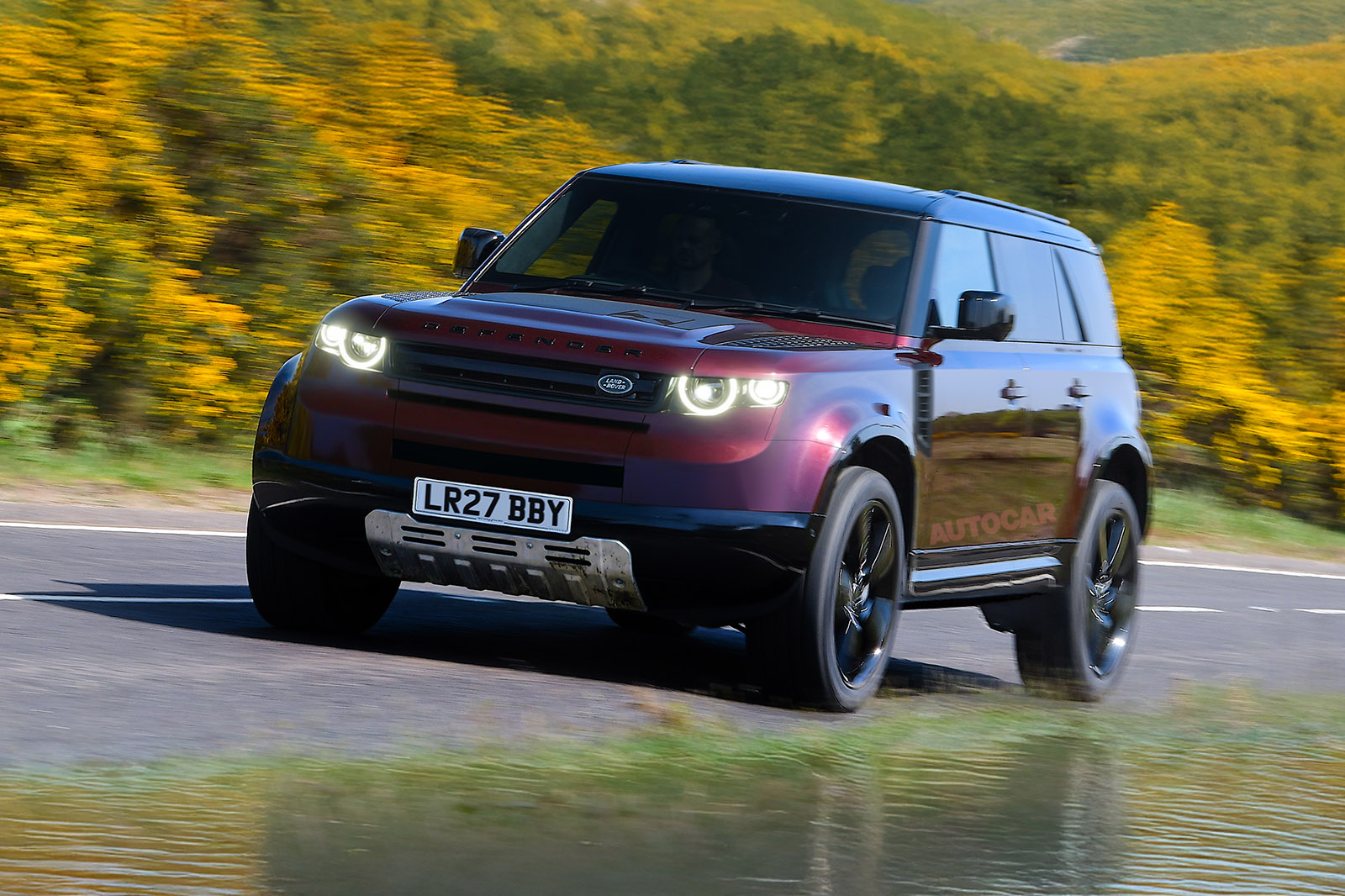
Work "well advanced" on Defender's smaller sibling – and bosses say it'll be nearly as good off road The new Land Rover 'Defender Sport' will arrive next year as both the smallest model and the first EV in the Defender line-up and the brand's boss has promised it will be "class-leading in the attributes that make it a Defender". The new model, already spotted testing on UK roads, is being developed on a new electric platform by JLR and will be smaller than the current Defender 90. Defender brand director Mark Cameron told Autocar that work on the new model was "well advanced" but wouldn't give a timescale for launch – or confirm if it would use the Sport name. Notably, the model will be the first entirely new product since Defender was turned from a Land Rover model line into a brand (along with Range Rover and Discovery ) under JLR's ' House of Brands ' approach. It will also be the first in an expanded range of Defender products. Defining Defender as a brand Cameron said the three years since the new plan was announced have been spent developing new products and establishing what Defender stands for. He added: "Over the past couple of years, our design and engineering teams have created that red line, the circle that every Defender had to have. That's the DNA." The Defender is currently offered in 90, 110 and 130 bodystyles, along with the hot Octa variant and the commercial Hardtop. Cameron said the focus was on making Defender "a luxury lifestyle brand", adding: "We've got a portfolio of one model with several variants, but I'm working seven to 10 years ahead to build out this whole brand portfolio. "We've got to make sure everything we do as Defender has the DNA of the brand: epic built-to-last, go-anywhere capability." Work 'well advanced' The Defender Sport is an entirely new product rather than an attempt to create an electric equivalent of the current Defender 90 – a decision driven by the design differences required by the use of a bespoke electric platform. Tipped to be just over 4.5 metres long, it sits on JLR'S EMA platform, which will underpin many of the company's future EVs, including the Range Rover Evoque and Velar . The more premium-focused Range Rover and Defender will use the firm's MLA platform, while Jaguar has developed its own bespoke EV architecture, named JEA. Using a platform with underfloor batteries creates "vehicle constraints", said Cameron. He added: "The size of the vehicle and platform will probably reduce wheel travel and articulation compared with a current Defender." But while that means the Defender Sport won't offer the same level of off-road ability as the current Defender line, Cameron has vowed that it will still be designed to offer substantial off-road capability. "What matters to us is that a Defender has to be class-leading in the attributes that make it a Defender," he said. That means it will retain four-wheel drive, suggesting a dual-motor set-up. Cameron said the emphasis on efficiency for EV design – vital to maximise range from the battery – created challenges "given the silhouette of what most people would know a Defender to be: very upright, sharp window angles, a bluff rear end". He added: "The capability we have in our vehicles carries a penalty that works against you when you think about range for an EV. My job is to make sure we retain Defender's DNA, otherwise we become another SUV brand and there are plenty of those." Cameron acknowledged that Defender EV test cars had already been spotted by Autocar's spy photographers and said the firm was "well advanced" with development. He also noted that the firm had put a focus on "maintaining our test cycles", rather than trying to chase a faster development cycle in order to keep up with Chinese rivals. "What has disrupted our industry hugely are shrunken test cycles due to some of the Chinese brands," he said. "Their speed to market is just incredible. But we have always maintained that we need to have at least two winter test cycles and two hot weather test cycles for a Defender. We're looking at ways to shrink our product development time, but we don't want to compromise on quality and longevity and all the things you have to deliver as a luxury brand." Cameron also indicated that JLR has put a focus on where it can best add value, saying: "As a business we're looking at where do we partner, and where do we build in-house, You've got to work out your core competencies. If you look at the EV world, the actual battery pack and the electric drive units have, to some extent, become commodities. But do they give us the torque characteristics and off-road drivability that Defender has to have? Those are big decisions: the quickest way to market is to buy all that in, but that's not necessarily the right answer for Defender." Brand building Cameron wouldn't be drawn on specific product plans beyond the brand's first EV, but when asked how big a potential Defender line-up could become, he said: "Huge." That is likely to include multiple powertrain options given what Cameron called "the complexity of EV adoption", which results in the level of customer demand lagging behind the expectation of legislators. That's a challenge given Defender's global footprint: a majority of its UK sales are currently diesel, while its biggest market is now the US, where electrification is firmly on the back burner. "Our strategy is to offer as much choice for as long as we can," said Cameron. "Clearly with the Defender, because of the capabilities, toughness, the weight and the geometry of it, as long as we can keep selling petrol and diesel with hybridisation and other forms of interim technology, we'll continue to do so." The Defender is currently offered with a plug-in hybrid powertrain, but that is built around a four-cylinder engine and has a limited electric range, because the D7 platform wasn't designed for the technology. Cameron hinted that would change in time, saying: "We're going to be relying on future generations and different architectures to expand those sorts of technologies." Notably, Cameron said Defender's growing international focus could Influence its line-up: "Beyond the UK there are vehicle types that are absolutely suitable [for Defender in certain geographies. The US is now our biggest market, and there are product categories popular there we can absolutely bring Defender into." That suggests a revival of previous plans to develop a Defender pick-up given the size of that market in the US, although Cameron wouldn't expand on specifics. But he noted that growth could also come at the other end of the range, because "in Europe they need small cars for tight streets". He added: "The red line we've got to draw is that any future versions of Defender still have to have the same characteristics that every Defender needs. There's no reason you can't go smaller, bigger, longer, higher and still cover those bases. "The biggest challenge is that we don't want to be all things to all people, so we've got to work out where to [focus] - and it's not about volume for us. It's about building a good, profitable, margin-led business and satisfying customer needs in segments and markets that don't exist today. "If you look at JLR as a business, we've always been at our best when we create segments. Range Rover is a great example. The Evoque was a great example. Defender today is a good example: it reimagined the rugged SUV segment. "So we're going to look carefully at those white spaces in the market where we can credibly have a Defender product. But we won't copy something just to chase volume, because that's not what our business plan is."