


 GB News
 Dragon’s Den entrepreneur shares how she transformed Covid lockdown idea into eco-friendly business success
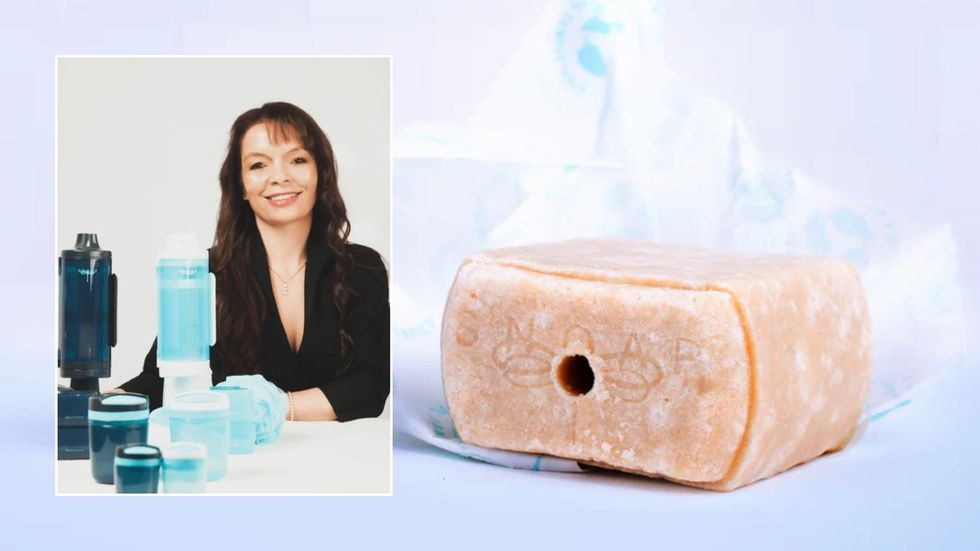
Diverting more than 10 tonnes of plastic waste and replacing around 800,000 bottles, Lisa Hicks has turned a lockdown frustration into one of the UK’s most promising sustainable household innovations. The founder of SNOAP — a solid soap dispensing system — did not set out to launch a business. Instead, the idea emerged during the Covid-19 lockdown, when daily routines slowed down enough to expose something most households rarely stop to consider: just how much plastic they use. Like many families, Hicks’ household went from partial occupancy to full capacity overnight. Suddenly, five people were at home all day, every day and with that came a visible surge in waste. On her business began, Ms Hicks said: “It wasn’t one single moment. It was more like a slow accumulation that hit me all at once. With Covid, we went from just me and the dog at home to all five of us, overnight. And suddenly I could see our waste." She explained: "Normally, families come together for longer periods at moments like Christmas, and you’re just busy making a good time. You’re not reflecting on your life choices. But lockdown forced that reflection on me. "I thought I was pretty eco-savvy. I really wasn’t. The number of bags and the amount of single-use plastic we were getting through weekly was shocking." Determined to understand the true scale of the issue, Ms Hicks began researching. What she found transformed concern into action. "In 2019 alone, UK households went through 686 million hand wash bottles, 617 million shower gels, and 520 million shampoo bottles, that’s 1.8 billion bottles, just from homes. Once you’ve seen those numbers, you really can’t unsee them." Her first instinct was simple: switch to solid soap bars, which eliminate the need for plastic packaging. But what seemed like an obvious solution quickly ran into real-world resistance. "My family was my best and worst focus group. My daughter wouldn’t touch a bar if her brothers had used it: boy germs, obviously. And my youngest turned it into a game, squeezing the bar until it flew across the bathroom." The soap dish itself became another issue, becoming messy, unhygienic, and widely disliked. Those objections, however, became the foundation of the product." Every single one of those problems is real, and they’re not unique to my family. Less than seven per cent of the UK uses solid bars, and that’s exactly why." Rather than forcing behaviour change, Hicks focused on removing the friction: "The design had to solve all of it , nobody touches the bar, nobody shares it, no soap dish." The result was Snoap: a refillable dispenser that houses solid soap bars internally and grates them into a fine powder as they are used. Each bar delivers around 1,000 handwashes and can replace dozens of single-use plastic bottles According to Ms Hicks: "The family essentially handed me the brief." LATEST DEVELOPMENTS High street retailer announces major closure in effort to 'help' save 500 stores Borrowing costs hit 2008 financial crisis levels as gilt surge puts 'pressure' on Rachel Reeves Thousands of Britons unable to make payments after major UK firm hit with IT error Transforming that idea into a functioning product proved far more complex than expected. The early versions failed to deliver the right consistency, forcing repeated redesigns. But the real challenge lay in the mechanics. "Most businesses do one, maybe two prototypes. I did seven. What I hadn’t anticipated was how mechanically complex a solid soap dispenser actually is. You have to maintain a continual, even pressure on the bar all the way down so it grates consistently." The engineering details were intricate. The bars needed to rotate to avoid uneven wear, while the internal structure had to prevent jamming, requiring precise calibration of angles, materials, and pressure: "We had to use self-lubricating plastics or the whole thing would jam." Support from her network proved invaluable. Drawing on contacts from her time living in Hong Kong and Vietnam, as well as her husband’s connections in the toy industry, Hicks worked with a German design engineer to refine the product. Despite solving a clear consumer problem, Ms Hicks faced a major hurdle familiar to many innovators: awareness, but this changed when she stepped into the Den. Appearing on Dragon’s Den in 2024, Ms Hicks secured investment from Deborah Meaden and Peter Jones after all five Dragons expressed interest — a rare outcome that underscored the product’s potential. "The biggest change was visibility. I’d invented something completely new. People couldn’t switch to SNOAP if they didn’t know it existed." The exposure proved transformative. Clips from the show amassed around five million views, driving a surge in demand when the episode aired. However, she is clear-eyed about what the investment really offers. "We had a massive uplift in orders. The Dragons aren’t there to sit with you every week and run your business. They open doors, help you sense-check decisions and make introductions at the right moment." Today, SNOAP operates across three key channels: direct-to-consumer via its website, retail partnerships, and a growing B2B arm supplying schools, businesses and distributors. This diversification has been key to scaling the business while maintaining resilience. But for Ms Hicks, growth is not just about expansion: it is about impact. Consumers benefit financially as well as environmentally. The average household can save over £100 a year by switching, while each refill delivers the equivalent of litres of liquid soap without the packaging. "I don’t see profitability and sustainability as being in tension. That’s what makes the model work. There’s no single-use plastic, and we’re not shipping essentially water around the globe." The company’s circular approach extends further. Returned units are broken down and reprocessed into new products, reducing reliance on virgin plastic: "Plastic is a forever material. So the product is designed to be refilled forever, not thrown away." As the business grows, Hicks is focused on ensuring that expansion remains aligned with its mission: "The bigger we get, the more bottles we stop,” she says. “But scale has to be responsible." That mindset has been shaped in part by her participation in the Government-backed Help to Grow: Management Course, which she completed in 2025. "It gave me a different lens to look through myself and my business. It taught me to scrutinise whether decisions are genuinely moving things forward, rather than just creating noise." For those looking to start their own business, Ms Hicks emphasises the importance of self-awareness: "The most important thing is being open about what you don’t know." Our Standards: The GB News Editorial Charter