


 Dawn Business
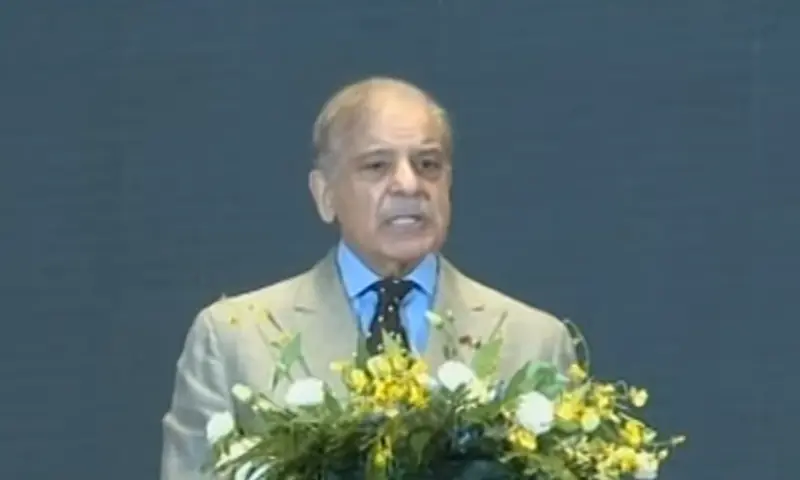
Prime Minister Shehbaz Sharif on Sunday highlighted four key areas with immense potential for bilateral cooperation between Pakistan and China. The premier landed in Hangzhou on Saturday, kicking off his four-day official visit to China. He will also visit Beijing, where he is expected to meet the top Chinese leadership. Addressing the Pakistan-China Business-to-Business Investment Conference in Hangzhou, PM Shehbaz listed four areas of importance for Pakistan-China cooperation: agriculture, IT, Special Economic Zones (SEZs), and mines and minerals. Noting that Pakistan was “basically an agrarian economy”, the premier noted the 1,000 Pakistanis who received advanced training in China last year were now back in the country “doing a great job”. He called for both countries to move forward, taking opportunities to improve per-acre yields and have high-quality seeds, best agricultural practices, and mechanisation through which the agricultural sector could be advanced “manifold”. “China imports every year about $100 billion worth of agricultural products from abroad,” he said. “Pakistan’s share is just a fraction … We will be able to produce agricultural products as per your requirements.” He stressed that if both countries worked together, they would be able to not only provide “massive” job opportunities to the rural areas of Pakistan but also create value addition by raising “hundreds of thousands” of small and medium-scale entrepreneurs there who would export items to China. “In the next five to seven years, we expect that we can increase our agricultural product trade to China by about $10bn,” he said. “And this is not a big task. It can be done, it is possible, not difficult at all — but we need your support,” PM Shehbaz said. The premier also drew attention to the potential of SEZs, highlighting that Karachi’s SEZ spanned over 6,000 acres. He stated that the government would be providing “all basic amenities” at the zone to encourage joint investments by Chinese and Pakistani entrepreneurs. “You will be offered a red carpet treatment,” he stated, adding that the investors would be offered land on long-term leases at “very attractive terms and conditions”. “We will have a world-class SEZ, and then that model will be replicated elsewhere in Pakistan through your great contribution,” he said. Pointing out that “labour in China has become pretty expensive” and that the country was moving towards a high level of industrialisation, PM Shehbaz invited Chinese investors to pursue joint ventures with Pakistani entrepreneurs in sectors where expensive labour had made China less competitive. The goods produced could be exported to third countries, creating a “win-win” situation for Chinese and Pakistani entrepreneurs alike, he said: “This will be … a roaring success in times to come, whether it’s textile or leather or other areas.” He invited Chinese investors to come to Karachi to see its export zone, saying, “Be our guest; we’ll play host to you, and you’ll have great opportunities to understand business propositions.” PM Shehbaz also noted the “huge potential” of the IT and artificial intelligence (AI) sector, and highlighted Pakistan’s large deposits of minerals and gemstones to encourage Chinese entrepreneurs to invest in the mining sector. He concluded by stressing that Pakistan was looking for “expertise, experience, investments — not loans, not aid, not handouts”. “Handouts [and] aid never made a nation vibrant, never made a nation stand on its own feet,” the premier remarked. He expressed his appreciation for President Xi Jinping’s “dynamic leadership” and the deep friendship between Pakistan and China. The conference discussed the sectors of IT and Telecommunications, battery energy storage systems, and agriculture. According to state-run Radio Pakistan , “cooperation and investment agreements and memorandums of understanding will be signed and exchanged between Pakistani and Chinese companies” at the conference. The business forum was aimed at promoting cooperation between Pakistani and Chinese companies under the second phase of the China-Pakistan Economic Corridor (CPEC 2.0). The premier will also meet with the heads of leading Chinese companies in Hangzhou, and will visit the headquarters of Alibaba Company. “During the visit, cooperation agreements between Alibaba and the Government of Pakistan will be signed,” the outlet reported. DPM Dar arrives in Beijing Meanwhile, Deputy PM and Foreign Minister Ishaq Dar arrived in Beijing on Sunday, accompanied by Planning Minister Ahsan Iqbal. He was received at the Beijing airport by Vice Minister of the International Department of the CPC Central Committee (IDCPC), Sun Haiyan. “I will be later chief guest on behalf of PML-N, at the 2nd Pakistan–China Political Parties Forum and the 4th CPEC Political Parties Joint Consultation Mechanism, alongside H.E. Mr Liu Haixing, Minister of the IDCPC,” the deputy foreign minister said in a post on X. Dar noted that the forum will bring together representatives from 12 political parties of Pakistan, including his PML-N. “Looking forward to productive discussions on strengthening political mutual trust, advancing high-quality CPEC cooperation, and deepening the enduring Pakistan–China friendship,” Dar said in another post . Earlier in the day, Dar also addressed the Pakistan-China B2B Investment Conference. “Over 500 companies from both sides are present in this hall. You are the driving force behind this partnership. This conference belongs to you: it is for you, and because of you,” he told the moot, according to a transcript shared by the Foreign Office. “Our government is pursuing an ambitious agenda of economic revival, industrial expansion, and sustainable growth. Over the past four years, we have achieved economic stabilisation, and the economic trajectory today is firmly upward, despite external headwinds,” Dar affirmed. He further said, “Today, you will also hear about another successful joint venture between Servis Group of Pakistan and Long March Tyres of China. Within five years, this joint venture is now about to create a billion-dollar joint venture company.”
Go to News Site