 Axios
Axios
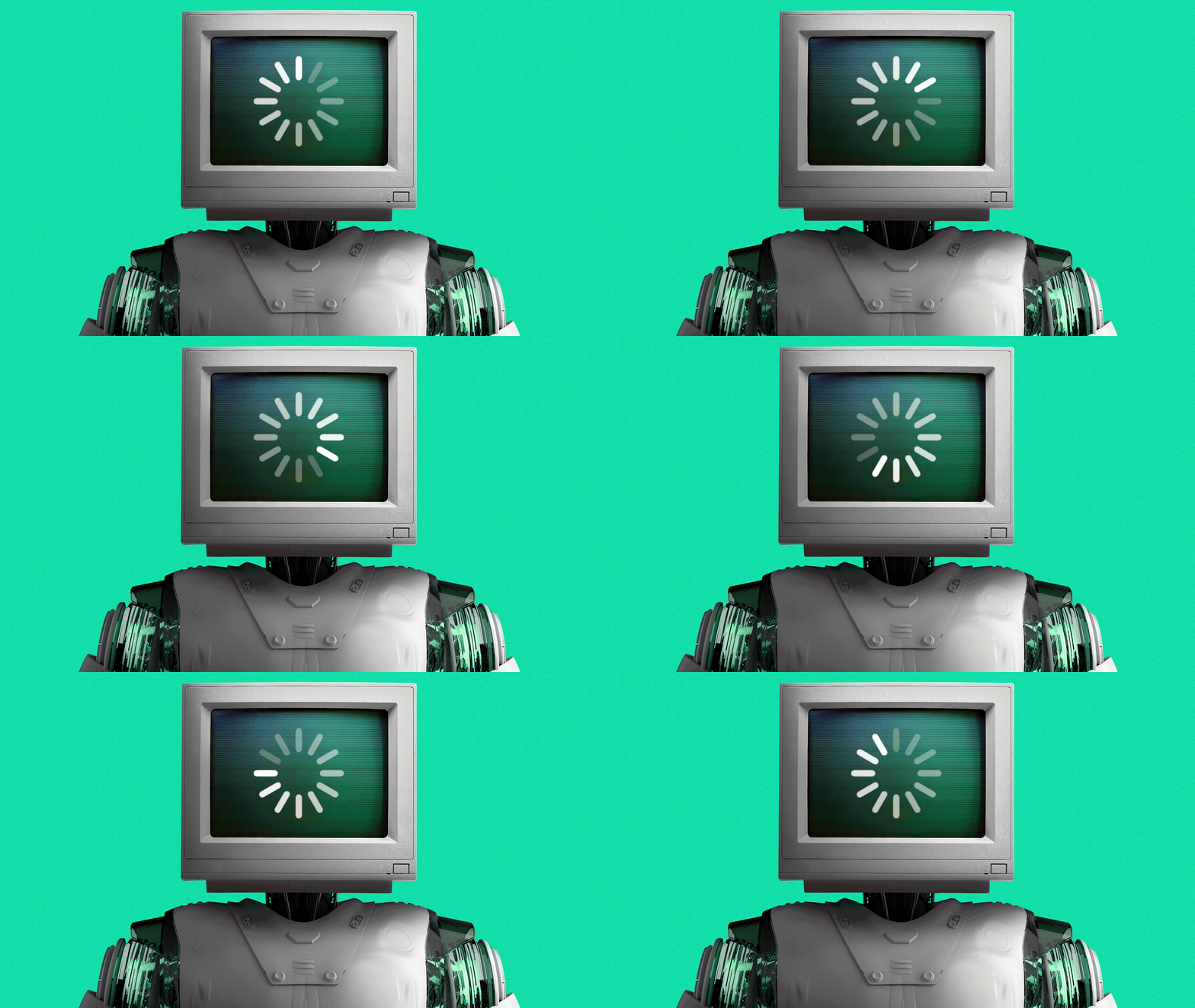
Axios CEO Jim VandeHei writes: I've spent the past year using AI obsessively — inputting copious amounts of personal and business data, turning myself into a lab rat for Axios and our readers. Why it matters: This experiment has shown me in unmistakable, hands-on ways the superhuman possibilities — and real-world limitations — hitting and awaiting us. In short: AI is way better, more accurate and mind-expanding than most think. (Sorry, it's true.) But it's colliding with hard human realities, making it confusing, clunky and chaotic for lots of people in its current form. How I did it: Over the past year, Axios aggressively tested AI (mainly OpenAI's Codex and Anthropic's Claude Code) across every layer of every department. We provided access and instruction to every employee. Most of my leadership team operates with chief-of-staff agents , and we're knee-deep in agent-to-agent prep. I personally use ChatGPT or Claude for one to two hours daily, usually in the early mornings, and control an AI personal operating system via my phone. That's connected to an always-on computer that runs several agents, including one that scans daily for CEO-relevant data and trends. I've dumped every medical record and blood test into it, and detailed my diet, workouts and supplements. It knows more about my health than my wife does! So here are my takeaways: It's way better than most think. I've spent the year with my head buried in this, while talking to the smartest people in tech, politics and business. AI is smarter than 95% of the people on 95% of topics, 95% of the time. Even for someone using it obsessively with real discipline, I'm still discovering it's way better than I thought possible. Its ability to think creatively and research deeply is extraordinary — if and only if you know how to use it. It takes real work. You can't wing it. You need to work at it daily, so AI learns you — and you learn AI. That's when the magic happens. You have to feed it copious amounts of information and persistently tell it what works and what sucks. This feedback loop creates a new form of super-knowledge about you — and super-skills for you. Most people get unimpressive results and move on, assuming it's overhyped. Don't. It's the smartest doctor I've met. I fed AI every medical record I have — MRIs, blood work, heart rate — and told it to be clinical and brutally honest. I've run most solutions past my doctor, and almost every time, he agrees. I still validate with physicians. But if I had to pick someone to diagnose something, I would turn to AI over human docs for anything complicated. Short-term job losses are overhyped. A year ago, I assumed AI's story would be subtraction : Automate ruthlessly, cut costs, shrink headcount. That's real. We've done it at Axios. But over the last three months, my view shifted. The bigger opportunity isn't efficiency. It's new business lines that were economically impossible before AI. We're exploring three new revenue-generating projects that simply weren't possible without AI. I now believe many specific jobs here will change, but that we'll end up hiring more people over time than I would've thought a year ago. Business gains are overhyped, too — for now. As good as it is, AI hits internal walls when it comes to human use, security, connections to other systems and decisions about what data it can access inside companies. In most cases, it's simply not ready for deployment at scale. This problem is getting worse because agent-to-agent work is a mess. If AI transforms our business — and I think it will — agents need to work flawlessly with other agents. This is the unfolding frontier. My exec team has chief-of-staff agents , but we hit constant walls in determining what they can know, share and act on once the agents collaborate. This must be fixed before companies experience what I have at an individual level. A new class of super-worker is born. Here's the best news: We're spotting rank-and-file workers daily whose brains are wired for AI . It's been easier than expected to spot them, then train them to be AI accelerators on their team or across the company. These people are not technologists. You don't need to be an AI savant or lab rat. But every person reading this should figure out ASAP how AI can augment their work. If your company does not have AI teaching, demand it. It's affected my mind, mood and performance. I'm not a coder and rarely use AI for more than that hour or two per day, but these stories about people in Silicon Valley getting swept up in a manic AI fever — AI-pilled! — hit home for me. On the good side, I've jumped out of bed at 3 a.m. more than I care to admit, jazzed to test or explore a new idea. At 55, I've written and accomplished a lot more than any other time in my life. But you must train it to challenge and expand your thinking — not replace it. On the flip side, I find myself waking up after shorter bursts of sleep with more anxiety. Maybe it's coincidence, not causation. But I doubt it. The bottom line: We're living history. For $20 a month, any of us can experiment with exceptionally advanced AI models. Be clear-eyed about the good, bad and ugly. But most importantly, be curious. Use it daily. Read about it regularly. Figure out what parts of you can be vastly improved with AI — and then do it. Watch a video of Mike quizzing Jim about his lab rat learnings. Tell us what you think: finishline@axios.com . If you're a CEO or on a CEO's team: Ask to join Jim's new weekly Axios C-Suite newsletter.
Go to News Site
 RT
RT 
 KPRC 2 Houston
 Michigan Live
 POLITICO
 njdotcom
 AL.com