 The Advocate
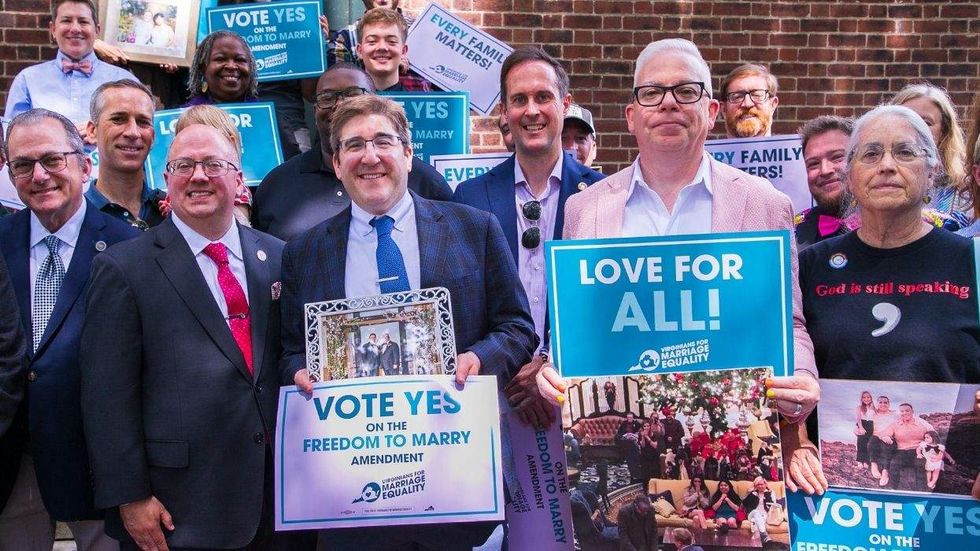
Twenty years after Virginia voters amended their constitution to ban same-sex marriages, a coalition of LGBTQ+ advocates, faith leaders , elected officials , and families is launching a campaign to erase that language and replace it with an explicit constitutional guarantee of marriage equality . The campaign, called Virginians for Marriage Equality, officially launched June 1 in Richmond, where supporters gathered to begin organizing for a statewide referendum that will appear on the November 3 ballot. If approved, the amendment would remove Virginia’s unenforceable marriage ban and affirm that two adults may marry regardless of sex, gender, or race. It would also require all legally valid marriages to be treated equally under the law. "This amendment is deeply important to me as a Virginia voter and deeply personal to me as a married woman," Narissa Rahaman , executive director of Equality Virginia and a member of the Virginians for Marriage Equality campaign committee, said during the launch event. Related : Virginia lawmakers pass marriage equality, abortion & voting protections The referendum asks Virginians to revisit one of the most consequential culture war battles in the state's modern history. In 2006, Virginia voters approved the Marshall-Newman Amendment, a constitutional provision defining marriage exclusively as a union between one man and one woman. The measure passed with 57 percent support amid a national wave of state constitutional amendments banning same-sex couples from marrying. The amendment also prohibited Virginia from recognizing legal statuses that approximated marriage, making it one of the broadest marriage bans adopted in the country. That language remains in Virginia's constitution today. Federal courts struck down Virginia's ban in 2014 in Bostic v. Schaefer, and same-sex couples began marrying in the Commonwealth later that year after the U.S. Supreme Court declined to hear Virginia's appeal. Marriage equality became the law of the land nationwide the following year with the Supreme Court's landmark ruling in Obergefell v. Hodges. But while the amendment is unconstitutional and unenforceable, it has never been removed from the state's founding document. Related : Virginia Gov. Abigail Spanberger sends marriage equality & abortion rights amendments to voters The effort to repeal the amendment gained momentum after the Supreme Court overturned Roe v. Wade in 2022. In a concurring opinion in Dobbs v. Jackson Women's Health Organization , Justice Clarence Thomas suggested the court should reconsider precedents grounded in similar constitutional reasoning, including Obergefell . Although no active challenge to marriage equality is currently before the Supreme Court, LGBTQ+ advocates have increasingly pushed states to codify protections that would survive a future reversal. Virginia is one of several states where constitutional bans on same-sex marriage remain on the books despite being unenforceable under federal law. In recent years, LGBTQ+ advocates have pushed states to repeal those provisions, arguing that state constitutions should reflect current law and provide additional protections should federal precedent change. "Over the next five months, Virginians for Marriage Equality will ask Virginia voters to have conversations with their friends, families, and neighbors — at kitchen tables, in living rooms, on front porches — about the things that matter most to us as Virginians," Rahaman said. "Our freedoms and our values." The referendum reached the ballot only after clearing Virginia's lengthy constitutional amendment process. Under state law, constitutional amendments must pass both chambers of the General Assembly in two separately elected legislatures before voters get the final say. Lawmakers first approved the marriage equality amendment in 2025 and gave it final legislative approval during the 2026 session, sending it to voters this fall. The launch event began with an interfaith prayer service at First Unitarian Universalist Church of Richmond before shifting to a public gathering featuring lawmakers, advocates, and Virginia families. Among the speakers were former state Sen. Adam Ebbin and former Del. Mark Sickles, longtime legislative champions of the amendment. Families shared stories about the practical importance of marriage recognition, from health care and parenting rights to inheritance and caregiving. "Marriage equality is what allows families like ours to navigate health care, school enrollment, parenting, caregiving, and all the ordinary parts of life that comes with making a home together," Chad Stewart said while appearing alongside his husband, Blake McDonald, and their daughter. Related : Virginia Democrats move to amend state constitution to protect marriage equality "No Virginia family should have to live under a cloud of uncertainty about whether their marriage and family will continue to be recognized and protected." Supporters also invoked Virginia's complicated place in the history of marriage rights. "The ACLU of Virginia has been fighting for Virginians' right to marry who they love since the landmark case, Loving v. Virginia ," said Mary Bauer, executive director of the ACLU of Virginia. The 1967 Supreme Court ruling struck down state bans on interracial marriage, including Virginia's own anti-miscegenation law. "Now we are proud to carry that legacy forward by standing with our coalition partners in the fight to pass this amendment and finally enshrine the right to marriage equality in the Commonwealth's constitution,” Bauer said. The marriage equality referendum will appear on a ballot that also includes proposed constitutional amendments protecting reproductive freedom and restoring voting rights to Virginians with felony convictions after release from incarceration.
Go to News Site
 Las Vegas Review-Journal
 The Daily Beast
 RT
RT 
 New York Post