


 Business Recorder
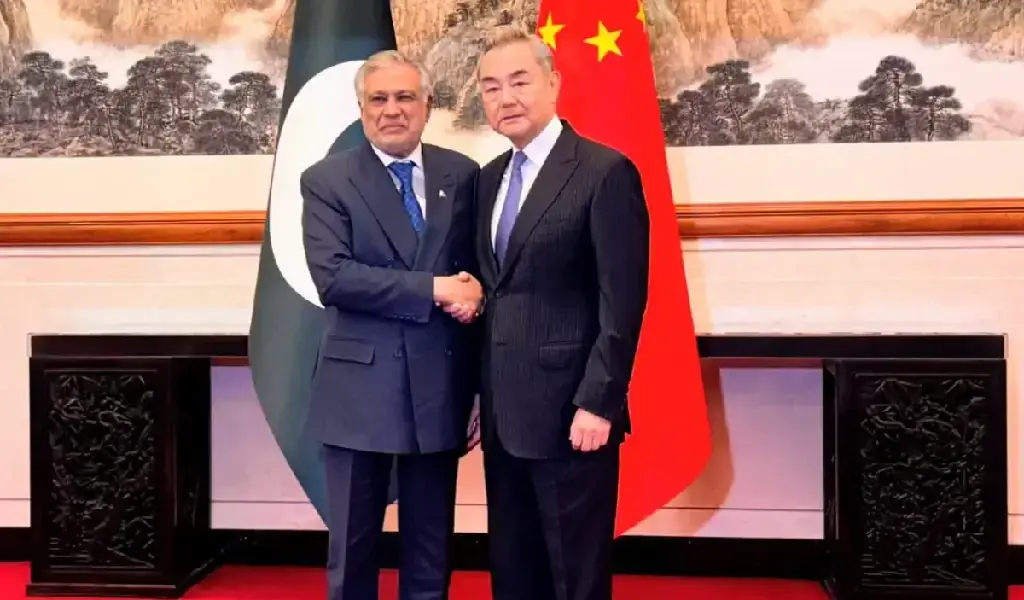
Pakistan and China on Tuesday put forward a five-point initiative to assess the evolving situation in the Gulf and the broader Middle East, as Foreign Minister Ishaq Dar held talks with his Chinese counterpart Wang Yi in Beijing, the Foreign Office said. Dar is on a one-day official visit to China at the invitation of Wang, during which the two sides reviewed bilateral ties and exchanged views on regional and global issues of mutual concern. This marks Dar’s second visit to Beijing this year and comes shortly after he chaired a quadrilateral meeting involving the foreign ministers of Saudi Arabia, Turkiye and Egypt to explore ways to end the ongoing Middle East conflict. READ MORE: China vows closer strategic coordination with Pakistan on Iran crisis amid Dar visit According to the Foreign Office, Wang — also a member of the Political Bureau of the CPC Central Committee — met Dar in Beijing, where both sides jointly proposed a five-point initiative focusing on the Gulf and Middle East situation. The five points are as follows: Immediate cessation of hostilities Both countries called for an immediate ceasefire and stressed the need for maximum restraint to prevent further escalation. They also underscored the importance of allowing humanitarian assistance to reach all conflict-affected areas. Early resumption of dialogue The two sides emphasized safeguarding the sovereignty, territorial integrity and security of Iran and Gulf states, reiterating that dialogue and diplomacy remain the only viable path to resolving disputes. They supported the early launch of peace talks, with all parties committed to avoiding the use or threat of force. Protection of civilians and infrastructure The statement stressed adherence to international humanitarian law, urging all parties to halt attacks on civilians and non-military targets. It also called for the protection of critical infrastructure, including energy facilities, desalination plants, power installations and peaceful nuclear sites. Security of maritime routes Highlighting the strategic importance of the Strait of Hormuz, both sides called for ensuring the safety of vessels and crew in the area. They urged the restoration of normal maritime traffic and safe passage for commercial shipping at the earliest. READ MORE: Dar to hold ‘in-depth discussions’ on regional developments in China tomorrow Upholding the UN Charter The initiative called for strengthening multilateralism and reinforcing the central role of the United Nations. It supported efforts to reach a comprehensive peace framework in line with the principles of the UN Charter and international law. Describing Pakistan and China as “all-weather strategic cooperative partners,” Chinese Foreign Ministry spokesperson Mao Ning said the two countries maintain close coordination on major regional and international issues. She expressed confidence that the visit would further enhance strategic communication, particularly on developments related to Iran. Pakistan’s diplomatic push The diplomatic push follows recent tensions triggered by US-Israeli strikes on Iran and subsequent retaliatory actions, which have raised fears of a broader regional conflict and impacted global energy markets. Dar said participants at the recent quadrilateral meeting supported the possibility of holding US-Iran talks in Islamabad and agreed to form a committee of senior officials to work out modalities. He reiterated that dialogue remains the only practical way to prevent further escalation and ensure lasting peace. In recent days, Dar and Prime Minister Shehbaz Sharif have also engaged with Iranian leadership, including President Masoud Pezeshkian and Foreign Minister Abbas Araghchi, while maintaining coordination with the United States. Dar said Pakistan values the trust shown by both Tehran and Washington and stands ready to facilitate meaningful dialogue between the two sides. ‘Diplomacy a gradual process’ Pakistan’s Ambassador to the United States, Rizwan Saeed Sheikh, said diplomacy remains essential despite being a gradual process. “Diplomacy takes time and patience, but efforts are underway to accelerate progress in the interest of regional stability,” he said in an interview with Fox News, expressing optimism about ongoing de-escalation efforts.
Go to News Site