


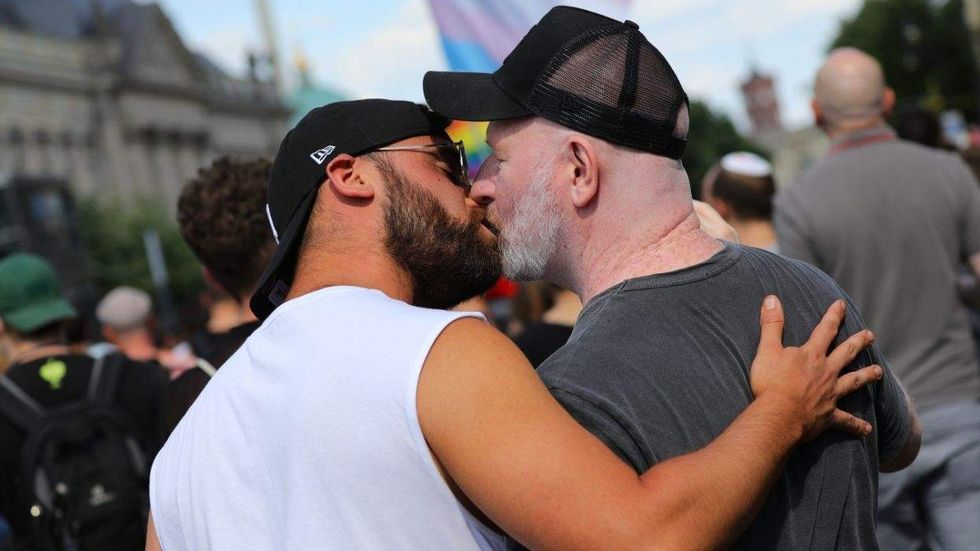
 The Advocate
The number of same-sex couples in the United States has more than doubled over the past two decades, even as political opposition to marriage equality shows signs of renewed strength. Keep up with the latest in LGBTQ + news and politics. Sign up for The Advocate's email newsletter. According to new data from the U.S. Census Bureau, about 1.7 million households in the country were headed by same-sex couples in 2024, accounting for roughly 1 percent of all U.S. households. That marks a significant increase from about 777,000 households in 2004. Of those households, about 836,000 included married same-sex couples, while roughly 551,000 were unmarried couples, according to the bureau. (The Census notes that totals may not align exactly due to differing survey categorizations.) Related : These LGBTQ+ married couples aren’t afraid to show their love Related : 18 of the longest-running LGBTQ+ celebrity couples Married same-sex couples have outnumbered unmarried couples since 2015, the year the U.S. Supreme Court’s decision in Obergefell v. Hodges made marriage equality the law of the land . But nearly a decade later, that legal foundation remains under political pressure. A coalition of conservative and anti-LGBTQ+ organizations has launched a coordinated campaign to overturn Obergefell. Groups involved in that effort include Them Before Us, the Family Research Council, Focus on the Family, the American Family Association, the Colson Center for Biblical Worldview, the Ruth Institute, CatholicVote, and the Christian Medical and Dental Association. Public opinion data suggests growing partisan divides. A Gallup poll released last year found Republican support for same-sex marriage fell 14 percentage points, from a high of 55 percent in 2021 to 41 percent—the lowest level recorded in the post-Obergefell era. At the same time, the Census data shows notable demographic and economic shifts within same-sex households. Same-sex married women now outnumber men, approximately 450,000 to 386,000, a reversal from 2004, when married men outnumbered women couples 214,000 to 178,000. Related : Which state is the gayest? Here are the 10 states with the most LGBTQ+ people Related : Gay men prefer cities whereas lesbians prefer the country, census (finally) proves Related : Which states have the most same-sex couples? Here are the top 10 The bureau also identified persistent gender-based income disparities. Median household income for lesbian couples was $108,500, compared to $104,500 for couples of gay men, despite similar employment rates. About 64.2 percent of female same-sex households and 64.7 percent of male same-sex households had both partners working. Among married couples, 60.8 percent of same-sex households had both partners employed, compared with 49.8 percent of opposite-sex married couples. The Census release coincided with new global data from the Pew Research Center marking 25 years since the Netherlands became the first country to legalize same-sex marriage. Since then, 40 countries have followed suit, most recently Liechtenstein and Thailand. Even in countries where same-sex marriage is legal, however, such unions make up less than 4 percent of marriages annually, according to Pew. Public support globally, and in the United States, has shifted dramatically over time. Pew found that 63 percent of U.S. adults supported same-sex marriage as of 2023, up from just 35 percent in 2001, when a majority, 57 percent, opposed it. Support is highest in Sweden, where 92 percent of adults back same-sex marriage and just 2 percent oppose it, according to Pew.
Go to News Site