


 Dawn Business
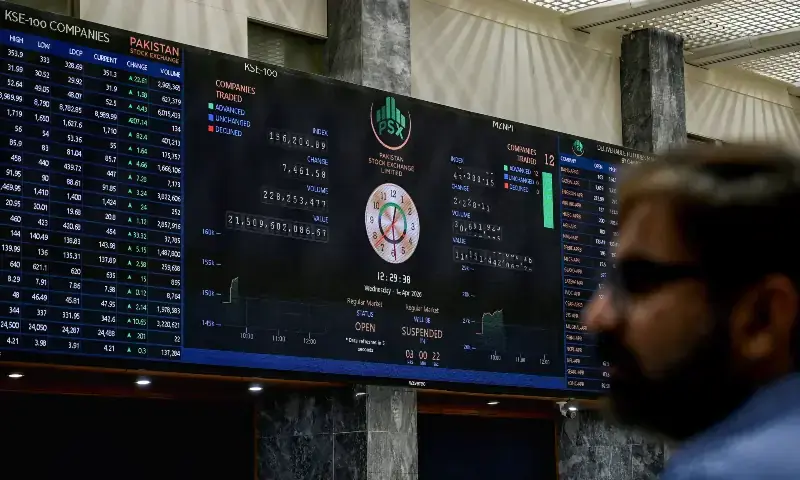
KARACHI: The Pakistan Stock Exchange (PSX) endured another volatile week as a historic surge in domestic petroleum prices, driven by tightening global oil supplies amid escalating tensions in the Middle East, unsettled investor sentiment and revived fears of renewed monetary tightening. Rising import costs, particularly for petroleum products and LNG, alongside weakening exports to Gulf markets, have begun to strain the fiscal outlook. Concerns deepened following reports that Pakistan is set to repay $2-3 billion to the UAE this month after the facility was not rolled over, adding pressure on already fragile foreign exchange reserves. According to Arif Habib Ltd (AHL), the benchmark KSE-100 index remained under selling pressure, closing at 150,399 points, down 0.9 per cent or 1,309 points week-on-week. Inflation accelerated, with the Consumer Price Index (CPI) rising to 7.3pc year-on-year in March, the highest since August 2024, compared to 7.0pc in February. Fuel prices saw unprecedented increases: high-speed diesel (HSD) surged by Rs184.9 per litre to Rs520.35, while petrol rose by Rs137.24 to Rs458.41 per litre. The petroleum development charge on HSD was removed, while the petroleum levy was raised by Rs55.24 per litre; the levy on petrol was reduced to zero. Macroeconomic indicators offered a mixed picture. GDP growth for the second quarter of FY26 was reported at 3.89pc, led by industry (7.4pc), followed by services (3.69pc) and agriculture (1.76pc). The trade deficit stood at $2.7bn in March, with exports declining 14pc year-on-year to $2.3bn and imports falling 5.4pc to $5bn. In the money market, the government raised Rs776.9bn in a Treasury Bill auction against a target of Rs750bn. Yields were mixed, with declines in one-month (29 basis points) and six-month (3bps) papers, while three-month (29bps) and 12-month (25bps) yields increased. Geopolitics, inflation fears keep investors cautious Pakistan’s public debt rose 1.1pc to Rs81.4 trillion ($290.6bn) in the first half of FY26, comprising Rs55.4tr in domestic debt (68pc) and Rs26tr in external obligations (32pc). Meanwhile, Federal Board of Revenue collections for March stood at Rs1,185bn, up 8pc year-on-year but missing the target by Rs182bn. Cumulative collections for 9MFY26 reached Rs9,307bn, falling short by Rs610bn. Foreign exchange reserves held by the State Bank of Pakistan edged up by $6.2 million to $16.4bn during the week, while commercial bank reserves rose by $47.8m to $5.4bn. The rupee remained largely stable, appreciating marginally by 0.025pc to 279.17 against the dollar. Sectoral data showed some resilience. Refinery throughput increased 13pc year-on-year, supported by higher output of HSD and petrol, while overall production rose 13.9pc with capacity utilisation at 58pc. Petroleum sales grew 19pc to 1.44 million tonnes in March, led by HSD (up 21pc), petrol (16pc) and furnace oil (62pc). Cement despatches rose slightly by 0.9pc to 3.74m tonnes, supported by exports amid subdued domestic demand. AKD Securities Ltd noted that market sentiment remained closely tied to geopolitical developments and sharp fluctuations in international oil prices. Early optimism during the week — supported by diplomatic efforts suggesting possible de-escalation, lower-than-expected inflation, and Pakistan securing a staff-level agreement with the IMF for $1.2bn — was later offset by conflicting signals from Iran and the United States, including concerns over potential military escalation. Trading activity weakened significantly, with average daily volumes declining 31pc week-on-week to 604 million shares. Among major developments, Pakistan secured Kuwait’s backing for fuel imports, engaged in diplomatic initiatives with China and regional stakeholders to ease tensions, and saw limited relief in shipping flows through the Strait of Hormuz. Sector-wise, refinery, woollen and transport stocks led gains, while vanaspati, leather and cable sectors lagged. Mutual funds were the largest net sellers, offloading $15.7m worth of equities, while individual investors absorbed most of the selling with net purchases of $16.7m. Looking ahead, analysts expect market direction to remain sensitive to developments in the Middle East and the start of the March quarter corporate earnings season. The KSE-100 index is currently trading at a price-to-earnings ratio of 7.4 times, offering a dividend yield of around 6.8pc. AKD Securities added that any easing of geopolitical tensions could trigger a rebound, as recent corrections have made valuations more attractive, with forward price-to-earnings ratios near 6.4 times. Published in Dawn, April 5th, 2026
Go to News Site