


 Business Recorder
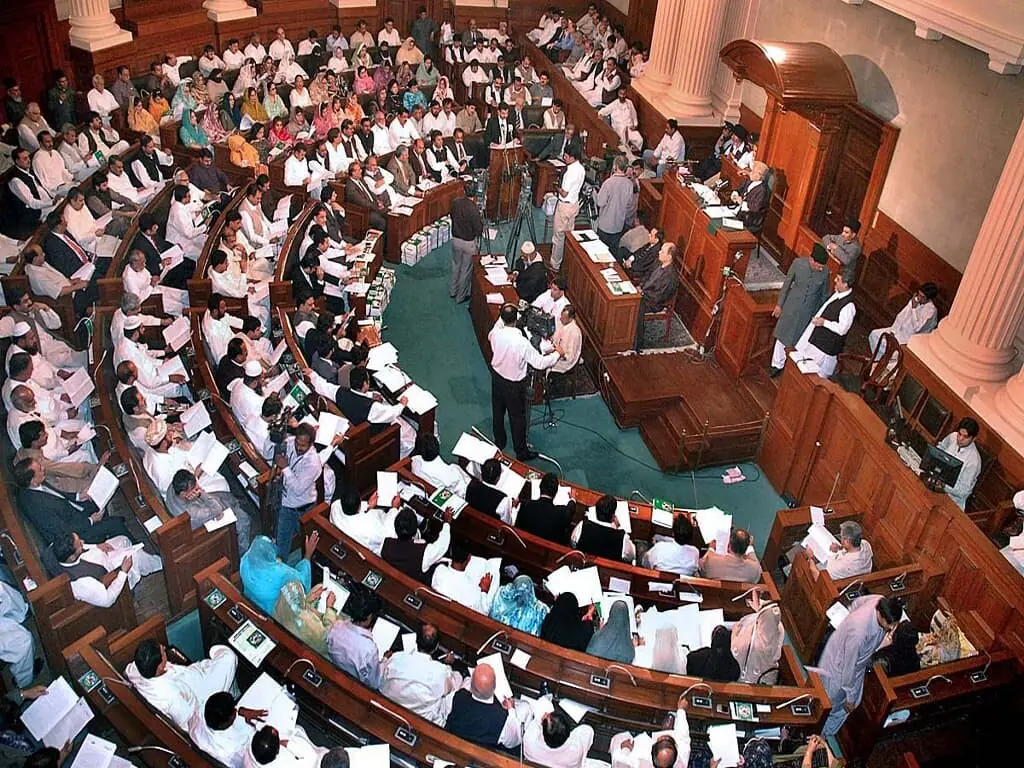
LAHORE: The Punjab Assembly on Monday witnessed the presentation of four major legislative instruments, including the Punjab Legal Aid Amendment Ordinance 2026, the Provincial Employees Social Security Amendment Bill 2026, the Registration Amendment Bill 2026, and the Public Sector Universities Amendment Bill 2026. Parliamentary Secretary for Parliamentary Affairs Khalid Ranjha tabled the measures before the house. Following their introduction, Panel of Chairpersons Samiullah Khan referred all four bills to the relevant standing committee for a period of two months for further review and deliberation. The session, which was convened on the requisition of the opposition, began one hour and seventeen minutes behind schedule with Speaker Malik Muhammad Ahmad Khan presiding over the proceedings. At the very outset of the session, members of the press gallery staged a walkout to protest the ongoing arbitrary dismissal of journalists from media organizations across the country. They returned to their seats only after assembly members Rana Arshad, Arshad Malik, and Iftikhar Chachar gave firm assurances that their concerns would be raised formally on the floor of the house. Addressing the assembly thereafter, Iftikhar Ali Chachar stated that he had visited the journalists on the Speaker’s instructions and confirmed that press representatives harboured no grievance against either the government or the opposition. He described the journalists’ position as entirely legitimate and explained that the day’s symbolic walkout was intended to draw attention to the unjust removal of media workers who had devoted their entire careers to journalism. Speaker Malik Muhammad Ahmad Khan extend his full support to the grievances raised and directed Chachar to draft a formal resolution on the matter, with the opposition to be included as co-signatories. Opposition Leader Moeen Riaz Qureshi, addressing the house, expressed deep regret that the debate on law and order was only beginning at six o’clock in the evening, calling the prolonged delay extremely unfortunate and a disservice to the legislature. He stated that the opposition comes to the assembly with one clear purpose, to hold the government and its ministers accountable on issues affecting the 115 million people of Punjab. Qureshi pointed out that the session was the first to be held in the aftermath of the Iran-Israel conflict, yet not a single government representative had risen in the house to condemn Israeli aggression, a silence he described as deeply shameful and wholly unacceptable for elected representatives. He made it clear that the opposition, as representatives directly answerable to the people, strongly and unequivocally condemned Israeli aggression. He stated that Iran was being subjected to relentless carpet bombing, with even children’s schools being deliberately targeted in the strikes. Qureshi urged the government to exercise extreme caution in navigating this sensitive regional situation, stressing that even its choice of words in public statements required careful and considered thought. He reminded the house that Iran is not merely a neighbouring country but one with which Pakistan shares deep religious and historical bonds that cannot be overlooked. The opposition leader called on the government to bring all political forces together under a single platform, resolve the country’s internal disputes as a matter of priority, and hold collective consultations to address the mounting economic crisis ahead. He argued that only a united and internally stable Pakistan would be capable of standing firm at its borders in the face of external threats and regional instability. Turning to departmental matters, opposition member Rana Aftab drew the house’s attention to a striking financial anomaly within the irrigation department, revealing that Punjab’s 412 irrigation rest houses had collectively generated a mere 371,000 rupees in revenue over an entire year, a figure he described as alarmingly inadequate given the sheer scale of the infrastructure. Irrigation Minister Kazim Pirzada agreed with Rana Aftab’s assessment, acknowledging that these rest houses were regularly used by members of parliament, departmental officials, and others, including during flood emergencies when they served an operational purpose. Raja Shaukat Bhatti raised serious concerns regarding the health sector, stating that despite billions of rupees being allocated to the department, lower-grade employees at local district health authorities were going without salaries for three to four months at a time. He further alleged that pharmaceutical companies supplying medicines to health facilities in Rawalpindi and other cities were being denied their due payments not on any legitimate ground but simply because they lacked personal connections with influential figures within the system. Parliamentary Secretary Asma Abbasi responded that under the terms of their contractual agreements, companies were legally bound to pay their workers on a monthly basis and that the health and population department was obligated to disburse 40,000 rupees per worker as per the agreed framework. Copyright Business Recorder, 2026
Go to News Site