


 Dawn Business
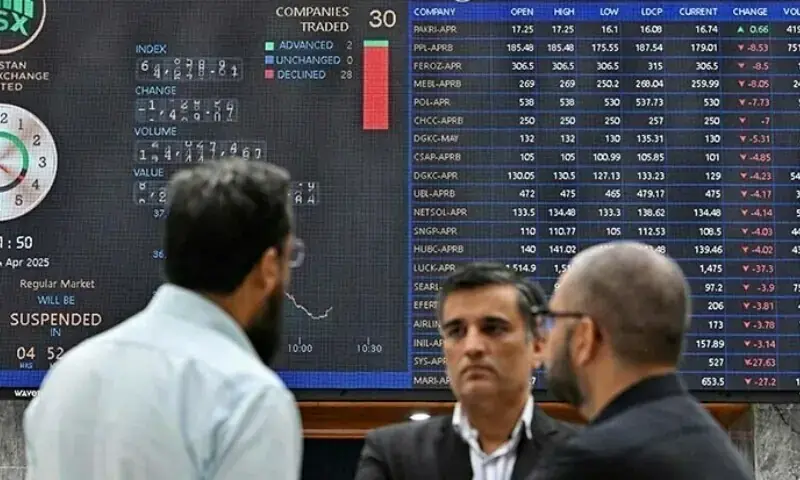
KARACHI: The Pakistan Stock Exchange (PSX) snapped a 10-week losing streak as easing geopolitical tensions, following a Pakistan-brokered temporary truce between the United States and Iran, lifted investor sentiment. The benchmark KSE-100 index posted a strong recovery during the outgoing week, closing at 167,191 points, up 11.2 per cent, or 16,793 points, week-on-week, marking its highest weekly gain since May 2025. Despite the surge, the index remains around 22,000 points below its all-time high of 189,166.83 points recorded on Jan 23. The market began the week on a cautious note amid geopolitical uncertainty but rallied sharply midweek after news of a two-week ceasefire and planned negotiations in Islamabad. The development triggered aggressive buying, with the index hitting an upper circuit staging an unprecedented 14,138-point rally, or 9.32 per cent, to close at 165,811, marking the largest single-day gain in the index’s history during Wednesday’s session. The average daily trading volume rose significantly to 918m shares, while the average daily traded value stood at Rs41 billion, reflecting improved participation. KSE-100 index up 11.2pc as easing geopolitical tensions triggered value-buying Mutual funds emerged as major buyers, with net purchases of around $51-54 million. In contrast, banks, insurance companies, individuals and foreign corporates were net sellers, offloading equities worth a combined $49m. On the macroeconomic front, workers’ remittances for March stood at $3.8bn, down 5pc year-on-year but up 17pc month-on-month. This brought total remittances in the first nine months of FY26 to $30.3bn, reflecting an 8pc annual increase. The government’s debt profile showed a modest rise, with central government debt reaching Rs79.9 trillion in February, up 0.7pc month-on-month and 9.4pc year-on-year. Pakistan also met key external obligations during the week, successfully repaying a $1.3bn Eurobond maturing on April 8, along with $126.1m in coupon payments on other issuances. Foreign exchange reserves held by the State Bank of Pakistan rose marginally by $18.6m to $16.4bn in the week ending April 3. Meanwhile, the rupee remained largely stable, appreciating slightly by 0.03pc to close at 279.01 against the dollar. Inflationary pressures persisted, with the Sensitive Price Index rising 12.15pc year-on-year and 1.93pc week-on-week. A notable development during the week was a sharp decline in international oil prices, driven by reduced geopolitical risk. Brent crude fell 12pc week-on-week to $95.92 per barrel, while West Texas Intermediate dropped 12.3pc to $97.87. Arab Light crude also declined by over 13pc to around $97 per barrel, easing inflation expectations and contributing to a decline in secondary market yields, with the three- and five-year tenors falling by up to 48 basis points. Pakistan’s Roshan Digital Account inflows reached $12.4bn by March, of which $2bn has been repatriated and nearly $8bn utilised domestically, leaving a net liability of $2.4bn. Other key developments included expectations of up to $50bn in financial support by the International Monetary Fund for vulnerable economies affected by Middle East tensions, a downward revision in Pakistan’s GDP growth forecast to 3pc by the World Bank, and a planned IMF mission next month to discuss the FY27 budget. Sector-wise, cement, engineering and textile stocks led the rally, posting gains of 17.3pc, 16.9pc and 13.8pc, respectively. In contrast, leasing companies and real estate investment trusts recorded modest declines. Analysts expect market performance in the coming week to hinge on the outcome of talks between US and Iranian delegations in Islamabad, as well as the start of corporate earnings announcements. Despite the recent rally, valuations remain attractive, with the KSE-100 trading at a price-to-earnings ratio of around 7-8 times and offering a dividend yield of over 6pc. Analysts believe sustained diplomatic progress and macroeconomic stability could support further upside in the near term. Published in Dawn, April 12th, 2026
Go to News Site