


 Dawn.com
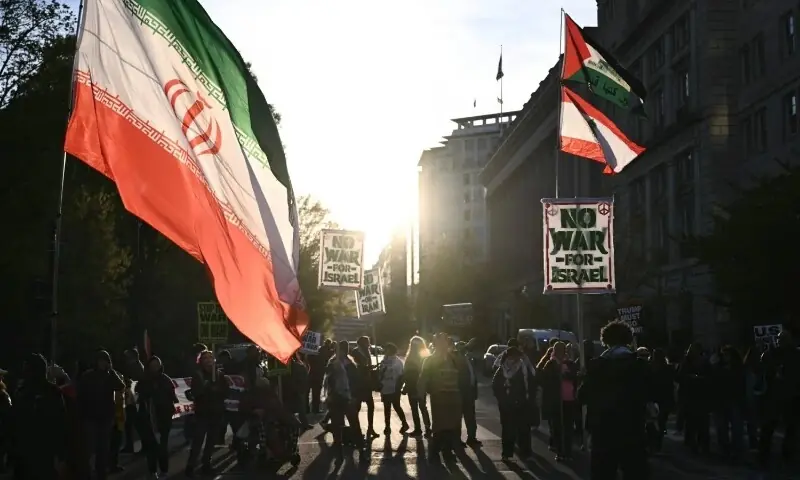
A historic meeting, 21 hours of negotiations, and one “final” offer. Yet, the high-level ‘ Islamabad Talks ’ between the United States and Iran ended inconclusively early Sunday morning. Although commentators and analysts say the dialogue was unlikely to end any other way, the heart wants what it wants, and the entire world sat on the edge of their seats, hoping for nothing short of a miracle. After a day and an entire night of talks, US Vice President JD Vance finally addressed journalists at a press briefing at 6:30am, where he announced the “bad news”. “We have not reached an agreement, and I think that’s bad news for Iran much more than it’s bad news for the United States of America,” he said, elaborating that Iran had chosen “not to accept our terms”. “We need to see an affirmative commitment that they will not seek a nuclear weapon and they will not seek the tools that would enable them to quickly achieve a nuclear weapon,” Vance added. Shortly after, he flew back to the US. On the other hand, Iran’s Parliament Speaker Mohammad Bagher Ghalibaf, also the leader of the Iranian delegation in Islamabad, said they raised “forward-looking” initiatives, but the US failed to win their trust during the negotiations. “The US has understood Iran’s logic and principles, and it’s time for them to decide whether they can earn our trust or not,” he wrote in a post on X. In the US, President Donald Trump started his Sunday morning with a barrage of threats directed at Iran. “I could take out Iran in one day […] I could have their entire energy, everything, every one of their plants, their electric generating plants, which is a big deal,” he said, during a phone interview on the Fox News show ‘Sunday Morning Futures with Maria Bartiromo’. Trump further announced that the United States Navy would begin the process of blockading vessels entering or leaving the Strait of Hormuz, citing concerns over maritime security and alleging that Iran had threatened shipping in the waterway. Iran has dismissed the warnings, saying that it had complete control of the Strait of Hormuz. But amid all the minute-by-minute developments, an urgent question remains unanswered: what next? What happened to the two-week ceasefire that pulled the world back from the end of “a whole civilisation”? Negotiations likely to continue According to journalist and analyst Zahid Hussain, the ceasefire would hold for now and the negotiations were likely to continue, at least through backchannel talks. “They have failed to reach an agreement but are discussing a number of issues,” he told Dawn . Hussain pointed out that there were two points where a deadlock persisted between the US and Iran: nuclear weapons and the Strait of Hormuz. “We were expecting the talks to lead to an extension in the ceasefire or some kind of agreement to resume negotiations.” On the other hand, he continued, was Israel’s position. “Tel Aviv had grudgingly and conditionally accepted the ceasefire,” the journalist recalled, adding that ever since the talks concluded, Israel had escalated the bombardment of Lebanon. “There are fears that they could do the same with Iran as well, which could lead to a compelling situation,” he said. “But there are signs that backchannel negotiations will continue and Pakistan could still play the role of a negotiator.” In an Al Jazeera report , Washington-based journalist John Hendren expressed a similar opinion, saying Trump’s decision to send Vance to Islamabad showed the seriousness with which the US was taking these talks. “The fact that Vance left doesn’t necessarily mean that the talks are over,” he said. “The US has been negotiating with Iran over time. Those talks can continue remotely, and leaving those talks may simply be a hard stance.” The ‘what if’ Speaking to Dawn over the phone, journalist Baqir Sajjad said that if the ceasefire holds, the immediate phase was likely to be one of “cautious pause rather than visible movement”. “Both sides appear to have used the Islamabad round to clarify positions, and any follow-up engagement would now depend on internal reassessments in Washington and Tehran. Diplomacy may continue, but in a quieter, more incremental manner, possibly focusing on limited understandings before attempting a wider settlement,” he said. In case the ceasefire doesn’t hold, Sajjad highlighted, the risk was that of a return to escalation, with both sides seeking to improve leverage before returning to the table. “Developments around the Strait of Hormuz or in peripheral theatres could become triggers. In such a scenario, the space for diplomacy would narrow, at least in the short term, even though backchannel contacts may remain active,” he added. A prelude? Meanwhile, writer and political analyst Trita Parsi, in an interview with CNN , noted that only six days had passed into the two-week ceasefire. “More rounds may occur since neither side has rejected further talks,” he said. “And perhaps neither side wanted an agreement right away, since it could give the impression that they gave in too quickly.” “Still, the most likely outcome is no deal, but also no return to a US-Iran war,” he added. Commenting on Trump’s threat of closing down the Strait of Hormuz, Iran’s foreign and security policy expert Hamidreza Azizi said, “One should not forget that in the past 40 days, Iran has been able to ship and sell its oil through the strait, while other oil-producing countries in the region have not.” “This means Iran is already 40 days ahead of others.” Similarly, Iranian-American academic Vali Nasr wondered if Trump’s naval blockade was aimed at escalating pressure on Iran as a prelude to another round of talks. “And Iran’s response? It could be pressure on shipping in the Red Sea? This is now even more than before a test of endurance between the US and Iran,” he wrote in a post on X. An ‘exposed’ ceasefire Currently, even though the ceasefire holds, analysts have called it fragile. Fatemeh Aman, Iran-Pakistan expert and senior fellow at the Atlantic Council, told DW that the ceasefire was not based on a political agreement. “It reflects a temporary pause shaped by caution and short-term calculations. Both sides are managing the situation rather than resolving it.” And this is why, it is all the more important that the truce holds and mediation channels remain intact, she said, adding that “without a follow-up diplomatic process, the ceasefire remains exposed”. “Neither side wants to appear as conceding after a failed round. There will likely be a pause as both reassess their position and leverage. If talks resume, they are unlikely to begin with the most difficult issues. “They will likely start with narrower, technical steps that reduce risk without requiring major concessions,” she added. Header image: Demonstrators flags of Iran and Lebanon during a protest against US military action in Iran near the White House in Washington, DC. — AFP
Go to News Site