


 Dawn.com
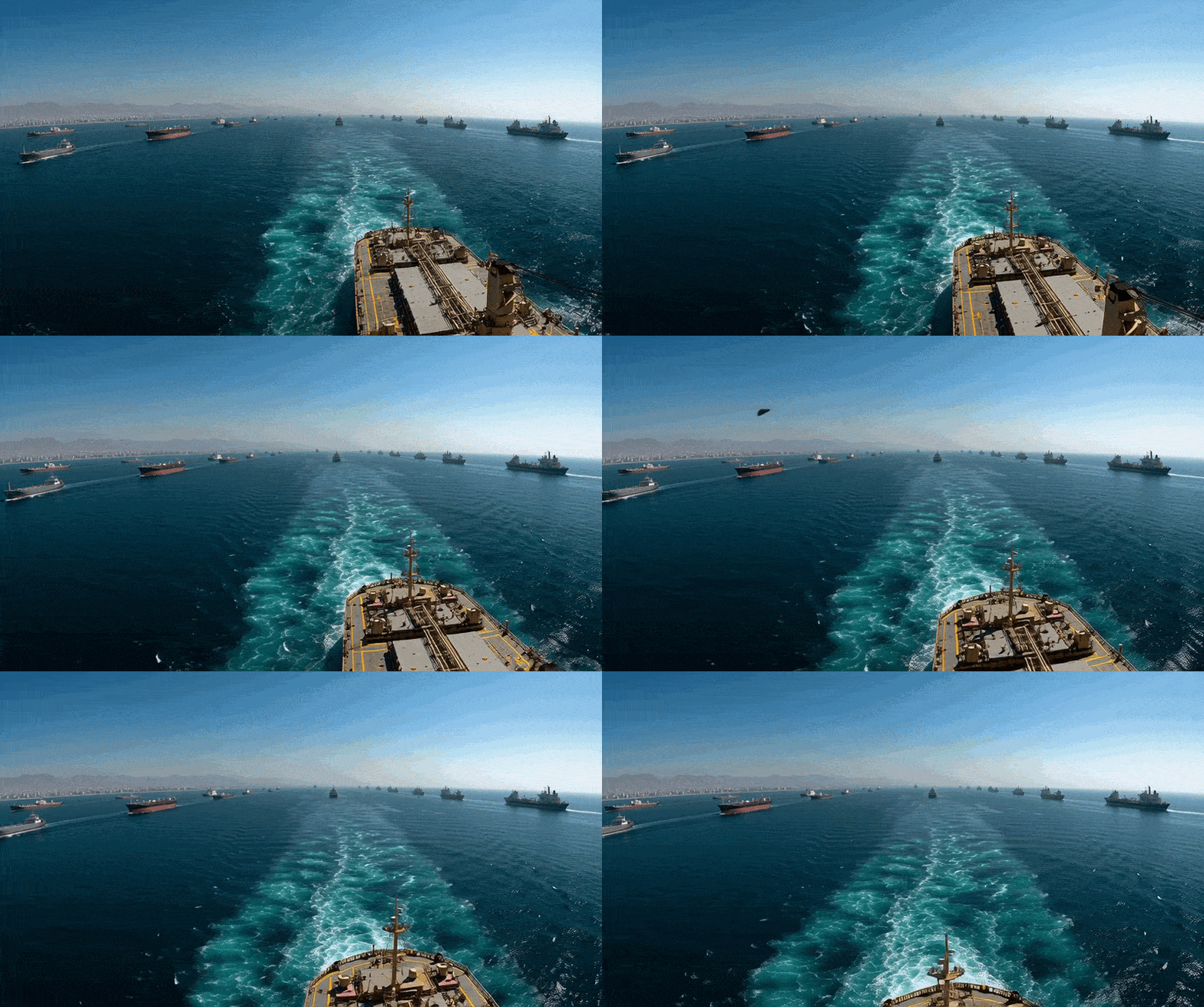
On Sunday, President Donald Trump stepped in to raise the stakes of an already volatile standoff, announcing that the United States Navy would begin “BLOCKADING” the Strait of Hormuz — delivered, in classic Trump fashion, the emphatic all-caps. The deadline passed at 7pm (PST) on Monday. The developments came after a night of diplomacy in Islamabad that promised more than it delivered, with inconclusive takeaways and very little to show for 21 hours of deliberations. The negotiations ended with a terse briefing from JD Vance, confirming what everyone had been hoping to avoid: nothing had been agreed. Judging from the string of off-the-cuff, rhetorically charged posts on Trump’s Truth Social feed, he appears to have revived what once again looks like the ‘madman theory’ — using brinkmanship and unpredictability as a strategic bargaining chip. He seems to be signalling that if Iran can rattle markets by blocking one of the world’s primary energy arteries, Washington can rattle them harder. The rationale is pretty straightforward: either every ship sails freely, or none do. But can he realistically do that? Can any state, however powerful, seal off a chokepoint governed by transit passage rights designed to prevent precisely this kind of unilateral control? Set aside the legal abstractions and a layperson is still left wondering: if Iran has effectively shut the Strait of Hormuz, what exactly is America threatening to block? How does one close a door that’s already been shut? As the world tries to make sense of a threat that seems to defy logic and law in the same breath, this piece turns to voices steeped in international maritime and security law to cut through the noise and explain its implications. The geography of law In a politically charged climate today where treaties are signed, unsigned, and at times strategically ignored, Dr Sikander Ahmed Shah, Professor of Law at LUMS, argued that the 1982 United Nations Convention on the Law of the Sea (UNCLOS) continues to bind states regardless of formal consent. He addressed a common misconception about treaty participation. While both Iran and the US have not signed the UNCLOS, he noted that they may nonetheless be bound by its core provisions, which have crystallised into customary international law. In this sense, customary international law is formed through consistent state practice and a sense of legal obligation. A notable illustration of this is how far a country’s territorial sea extends. Today fixed at 12 nautical miles, this boundary was not always so. Historically, many states followed the “three-nautical-mile rule.” This limit was based on a practical military consideration: coastal artillery in earlier centuries could only fire cannonballs about three nautical miles out to sea. So, states treated only that distance as the area they could realistically defend and control. As a result, ships from other countries would stay beyond this range to avoid provoking coastal defences. Over time, this repeated practice, accepted by others, solidified into customary law. Before any discussion of blockades or chokepoints, Shah insisted on understanding the basics: the layered structure of maritime zones. A map showing the coastal sovereignty of Iran with respect to the Straight of Hormuz. Map: Dawn GIS “States exercise full sovereignty over the first 12 nautical miles of sea adjacent to their coast which is termed as the territorial sea,” he explained, adding that beyond that stretches the 200-nautical-mile exclusive economic zone (EEZ), and further still, in some cases, the continental shelf that can extend up to 350 nautical miles. Each layer, as he described it, is a negotiated gradient of sovereignty and must be treated as that. The Strait of Hormuz problem Shah addressed the question of navigation rights that govern who can move through the territorial sea and under what conditions. He said that every ship, vessel, submarine or a military ship, has a right of innocent passage in the territorial sea. But this right is not unlimited and comes with strict behavioural conditions: “the passage must be non-threatening, continuous, and with no belligerent intention,” he underlined. He acknowledged, however, that states retain the ability to restrict it in exceptional circumstances. “Innocent passage can be suspended by a country whose territorial waters it is if they are in a war,” he said, adding that if framed in this context, “Iran can disrupt it.” In the case of EEZs, which can extend up to 200 nautical miles, the rules become more permissive but differently structured. Here, foreign vessels and aircraft enjoy the freedom of navigation and overflight, which includes the right to transit . This layered legal geography becomes most sensitive in strategic waterways such as the Strait of Hormuz. Here, Shah explained, geography and law collide. “The complication arises because the strait sits between coastal states — Iran on one side and Oman on the other — each entitled to territorial seas extending 12 nautical miles from their baselines (the starting point from which a state’s maritime zone is measured),” he said. But, he stressed, the Strait is not just a simple geometric space divided evenly between two coasts. Its legal character is shaped by a fragmented geography, particularly on the Iranian side, where islands complicate how maritime boundaries are drawn. In international law, he said, “not all land is equal in legal weight.” “The point of this is to understand that a lot of the water that is in the Strait of Hormuz might be considered Iran’s internal water,” he observed. Iran, he added, would likely argue that its baseline should be drawn in a way that incorporates the offshore islands as part of its territorial framework, effectively treating them as extensions of Iran’s land territory. If such an interpretation were accepted, it would dramatically alter the legal framework governing the Strait, suggesting that the usual rights of navigation would cease to apply altogether. A screenshot from a vessel tracker showing the marine traffic around the Strait of Hormuz at 2am (PST). Screengrab via VesselFinder Building on a similar premise, public international law practitioner Ahmer Bilal Soofi said that “a blockade is a historic practice that may be exercised by any party to an armed conflict as a belligerent right, but only during a situation of armed conflict and subject to certain legal conditions.” “In the specific case of the Strait of Hormuz, there is an added complexity because Oman and Iran have overlapping jurisdiction in adjacent waters, and under Part III of the UNCLOS, they can regulate transit passage by designating sea lanes and setting certain navigational arrangements,” he told Dawn . In his view, against this legal backdrop, the US announcement of a blockade would constitute a belligerent act, suggesting that a ceasefire may have ended unless the involved parties act otherwise. “This is a development that would need close observation in the coming days,” he said. An act of aggression or self-defence? According to Ayesha Malik, director of the War Law Institute, a US blockade of the Strait of Hormuz may amount to a serious breach of international legal norms and could be classified as an act of aggression under established frameworks of international law. She pointed specifically to Article 3(c) of the United Nations General Assembly’s Definition of Aggression and Article 8bis(2)(c) of the Rome Statute of the International Criminal Court, both of which identify maritime blockades as a prohibited form of force when carried out by one state against another. She argued that such an action would fail to meet the legal threshold of self-defence and would lack the necessary authorisation from the UN Security Council. In the same vein, Shah, questioned Washington’s imagined role in the Strait of Hormuz. “In what context is America planning to block the strait? It doesn’t have a coast there,” he said. He warned that if naval assets are used to physically prevent Iranian ships from moving, the act begins to resemble something far more serious than navigation enforcement. “In that sense, what is being discussed edges into the language of war. Naval blockade can be seen as an act of violence,” he said, adding that the justification being floated under Article 51 — the right to self-defence — is, in his view, legally stretched. At the same time, Malik drew a distinction between hypothetical blockade scenarios and the current situation involving Iran. “Iran has not currently blockaded the Strait of Hormuz because a blockade is defined as an effective prevention of access of vessels and aircraft of all states to and from specific coastal areas that are part of or under the control of an enemy state,” she observed. She stated that Iran is allowing neutral vessels to transit the state and blocking access to enemy warships as it is required to do under the UNCLOS legal framework. In the rare chance that Trump pulls a Trump Malik outlined the four criteria that any US blockade must satisfy under the law of naval warfare (these requirements apply regardless of whether the blockade itself constitutes an unlawful act of aggression). Notification — a blockade must be notified by the US which includes the following details given through Notices to Mariners (NTM) and Notices to Airmen (NOTAM): The date the blockade begins, Its geographical limits, and The general scope of measures employed, including a grace period for neutral vessels and aircraft to leave the blockaded area The blockade must be effective in that sufficient military assets are deployed to implement it and prevent access to the enemy’s coast. It must be impartial in that it is enforced against all vessels, regardless of flag or status. The blockade must comply with humanitarian concerns, including that it cannot be intended to starve the civilian population or deprive it of objects essential to its survival. As a result of this requirement, the blockading party must provide free passage of foodstuffs and other essential supplies, including medical supplies. She further said that in enforcing the blockade, if a neutral ship resists capture, it may be “attacked”, but the level of force must be proportionate to the level necessary to achieve the military objective and “ warnings must be given to the vessel prior to any attack ”. Malik added that the military advantage of the attack needs to be weighed against the collateral casualties. If the latter are excessive, the attack would be illegal. “If the American blockade does not comply with these conditions, it will also fall afoul of the law of naval warfare as well as the law relating to the use of force,” she explained. A blow to world economy Shah remained sceptical of the practicality of such a move. If a full blockade is imposed, he argued, it would be a sweeping economic shock. “If Trump entirely blocks the transport of oil, that no ship can come or go, it can only block from outside. The American navy cannot enter the Strait of Hormuz,” he said, suggesting that enforcement would have to occur at the margins of the waterway. In his telling, the strategy is more about pressure politics. “The intention might be to stop Iranian ships from entering and exiting its port but this will antagonise the international community,” he observed. He widened the frame beyond Iran-US confrontation to the global system that depends on uninterrupted maritime trade. “Commercial activity is not dependent on what America wants or not, they are market driven,” he said. The consequences, he warned, would not remain contained in the Strait. “American inflation will increase and the global economy will worsen,” he said, adding bluntly: “I don’t think he is in the financial position to do this; it would backfire and create more pressure on him and the local populus.” He pointed to the wider geopolitical fallout the move could unleash, stressing that China relies on Iran for more than 80 per cent of its shipped oil. Any interruption in those supplies could therefore be seen as, even unintentionally, the US inflicting economic pressure on China. Currency, he pointed out, is part of the contest. “The toll that Iran is charging is in Yuan; they’re not using US dollars,” he said. Any disruption, he asserted, would interfere with an emerging monetary realignment — one that benefits China as its currency gains traction in energy trade, but would also be curtailed if such flows were interrupted. Ultimately, Shah returned to a broader critique of the idea that any single state can meaningfully orchestrate global trade flows through coercion at sea. “While Trump’s plan is framed as a way to squeeze Iran by targeting its shipping, the irony is that most of the vessels in question aren’t even Iranian. In practice, the fallout would likely travel much farther than its intended target, unsettling global trade and sending ripples through the wider economy,” he said. “They’re trying to hurt Iran’s ability to decide everything. From an international law perspective, that is undoubtedly problematic. You can’t control how the economy or capital works,” he concluded. Empty vessels make the most noise? Oves Anwar, Director of the Research Society of International Law, said that although the Islamabad talks were not as fruitful as hoped, only this round of negotiations has ended. “The ceasefire is still in place and dialogue can still continue. At the moment, both sides are likely using this pause to reassess their next steps,” he put forth. Per Anwar, within this period, Trump appears to be purposefully “lighting a fire” under the situation. “By imposing this blockade, he’s trying to get things moving in typical Trump fashion. But it’s akin to having a siege around a siege outside a castle. It doesn’t make sense,” he added plainly. He said that while this move functions as a provocation that could potentially undermine the ceasefire, it is primarily a pressure tactic. “In fact, given that both sides are experienced in brinkmanship, they are capable of manoeuvering without immediate escalation.” “On realistic grounds, a blockade would take time to fully implement, especially if it involves assembling a multinational coalition of naval forces as Trump claims. That process could take days, if not weeks. In the meantime, there remains a window during which active hostilities can still be paused,” Anwar said. He added that, from both a legal and strategic perspective, a blockade is often characterised as a defensive rather than an offensive measure. “It could therefore be argued to fall within the scope of a ceasefire arrangement,” he claimed. The illusion of control And so we arrive at the modern paradox of Hormuz: the more loudly someone claims to control it, the more obvious it becomes that nobody really does. Not fully. Not cleanly. Not without consequences ricocheting far beyond the Strait itself, into inflation curves, oil prices, and political talking points. It is in this gap between claimed control and actual fragility that a newer logic of power has emerged. Perhaps this is the real madman theory update for the 21st century: it is no longer just erratic behaviour that passes for strategy, but the weaponisation of forewarned chaos. Instability is designed to be anticipated, unfolding in the shadow of international laws that, on paper, remain fairly unambiguous. Yet, those with disproportionate power keep redrawing the boundaries of possibility with offhand threats, while the rest of us are left trying to square the circle, unsure whether we are witnessing an escalation, a plot twist, or simply another Sunday in global politics. Header graphic created with Generative AI
Go to News Site