


 Business Recorder
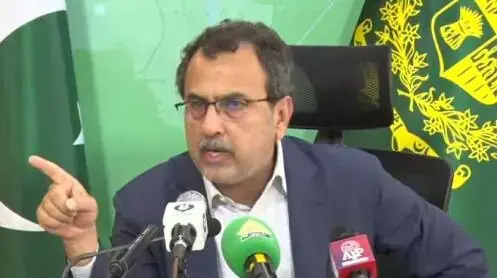
ISLAMABAD: Minister for Power Sardar Awais Ahmad Khan Leghari said on Thursday that power load-shedding during peak hours will continue until the supply of Liquefied Natural Gas (LNG) is restored, which is currently unavailable due to a force majeure declared by Qatar. Addressing a press conference on the reasons behind nationwide load-shedding, the minister clarified that the situation does not apply to the jurisdictions of K-Electric and the Hyderabad Electric Supply Company (HESCO), where only economic load management is being implemented, as sufficient generation capacity is available in the South. However, despite this availability, power cannot be transmitted to the North due to a system constraint of a base load below 14,000 MW. Leghari apologized to the public for the ongoing power outages, attributing them to a combination of fuel shortages, reduced hydropower generation, and rising electricity demand. READ MORE: Country grappling with massive power shortfall “The current load-shedding is a compulsion due to disruptions in gas supply amid the ongoing situation in the Middle East,” he said, adding that reduced water releases from Mangla and Tarbela dams, along with declining hydropower generation, had forced the Power Division to initiate peak-hour load management. He explained that recent rainfall has reduced agricultural water demand, resulting in lower water releases for hydropower generation. He said the current electricity shortfall stands at around 4,500 megawatts. The minister said the government has always worked to reduce darkness in the country and is actively promoting solar and other renewable energy sources to reduce dependence on costly fuels. However, he acknowledged that the current crisis has been worsened by the suspension of LNG supplies, creating a significant fuel gap. He revealed that LNG unavailability has caused a generation shortfall of over 3,200 MW, while reduced hydropower output has added another 1,600 MW, putting immense pressure on the power system. According to the minister, electricity demand in April has fluctuated between 9,000 MW and 20,000 MW. He noted that when demand exceeds 16,500 MW, load-shedding becomes unavoidable. “As hydropower generation improves, load-shedding will gradually come to an end,” he assured. Leghari further said that global developments, including disruptions linked to regional conflicts, have impacted gas availability and deepened the energy crisis. He maintained that load-shedding is being carried out in a fair manner across urban and rural areas, including the industrial sector. To bridge the shortfall, the government is currently generating around 1,400 MW using furnace oil, despite its high cost. He said the recent decision to impose up to two-and-a-half hours of load-shedding was aimed at controlling electricity prices and avoiding a heavier financial burden on consumers. The minister explained that for every 500 MW shortfall, an additional one hour of load-shedding is required. However, he clarified that no load-shedding is being carried out in HESCO and K-Electric areas, which are currently drawing around 2,100 MW from the national grid. Responding to a question regarding LNG procurement, Leghari said spot market prices of USD18–22 per MMBtu make purchases economically unviable. He added that spot cargoes are expected in May and that the government is in contact with Qatar. “We are closely monitoring global conditions, which are gradually improving, and we expect better fuel availability and improved hydropower generation in the coming weeks,” he added. On economic load management, the minister said efforts are underway to formalize the mechanism. However, he warned that abolishing it would add around Rs400 billion to circular debt. He further cautioned that increased reliance on furnace oil could raise the fuel price adjustment (FPA) by up to Rs1.30 per unit. “The complete resolution of the electricity crisis is conditional upon stable LNG supply,” he emphasized. Leghari also noted that administrative measures such as early closure of commercial markets are helping save up to 1,200 MW of electricity. He said the government has also extended maintenance schedules of nuclear power plants for a few weeks due to the current demand-supply gap. Criticizing political and non-political voices, he said some stakeholders were commenting on the situation without considering ground realities. Responding to another question, the minister said that if shops are not closed early, an additional 1,200 MW shortfall would emerge, translating into about 1.2 more hours of load-shedding. He added that generation through high-speed diesel (HSD) is possible, but would cost around Rs100 per unit. He reiterated that there is no discrimination between urban and rural areas in load management, and even the industrial sector is facing similar conditions. Concluding his remarks, the minister said the current load-shedding is temporary and expressed optimism that improvements in fuel supply and hydropower generation will soon stabilize the situation. Copyright Business Recorder, 2026
Go to News Site