


 Forbes India
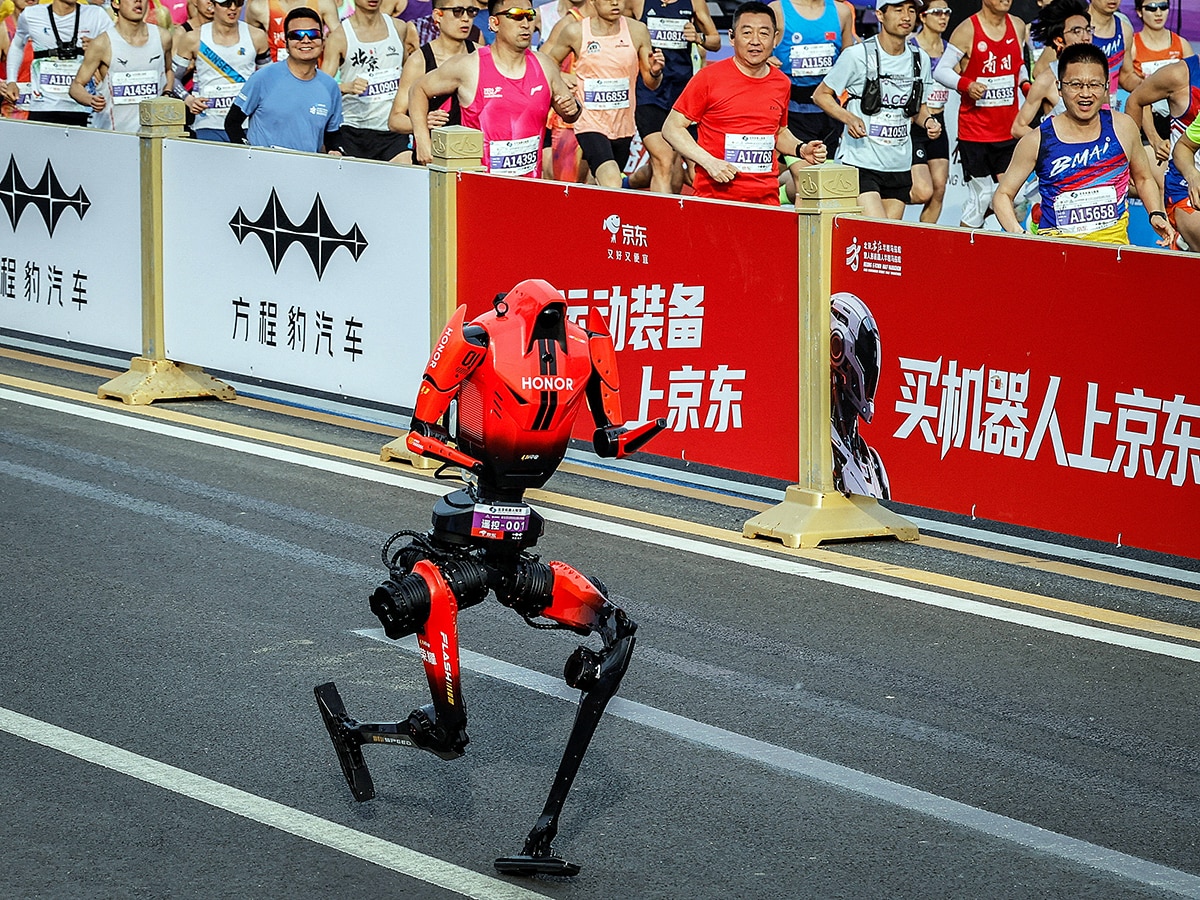
When IBM’s Deep Blue defeated Garry Kasparov in a chess match in 1997, it became the first computer to beat a reigning world champion. The match marked an inflection point in our understanding of how far computers had come. That’s a reality we keep confronting.Almost three decades later, on April 19, a humanoid robot called Lightning ran a half-marathon faster than any human ever has.For centuries, humans have drawn two comfort lines in their standoff with the machine: Mind and body. The mind was defeated decades ago in New York. The body fell this month in Beijing.Lightning, the bright-red humanoid built by Chinese smartphone maker Honor, completed the Beijing E-Town Half-Marathon in 50 minutes and 26 seconds, besting all 12,000 human competitors and even surpassing the human world record, set by Uganda’s Jacob Kiplimo in Lisbon last month, by nearly seven minutes.The fastest human in the race, Zhao Haijie, finished in 1 hour, 7 minutes and 47 seconds. “It just went whoosh right past me,” the 29-year-old told NBC News after the race.The pace of the development is stunning. Last year, the fastest robot finished the same race in 2 hours, 40 minutes and 42 seconds. The performance of the machines at the time was comedic. Several fell at the starting line. One simply lay down.This year’s race featured over 300 robots. At least four posted sub-one-hour times. The change from 2025 to 2026—from six finishers out of 21 to more than 100 teams competing with autonomous navigation—represents the kind of year-over-year progress that makes the event significant beyond spectacle.It took Deep Blue a year of upgrades to return and beat Kasparov. For Lightning, the entire development-to-marathon-entry process reportedly took one year. And it was developed by a smartphone maker, not a robotics firm.Honor has committed $10 billion over five years to AI development and unveiled its humanoid programme at Mobile World Congress on March 1. Seven weeks later, its machine crossed the finish line—literally.To be fair, Lightning was not immaculate. It crashed into a railing near the finish line and had to be helped back up before completing the race.What’s noteworthy is what the development shows about the advancement of technology and new winners who will emerge in the AI age.The half-marathon may be one small step for robot, but it was one giant leap for robotkind.
Go to News Site