


 Business Recorder
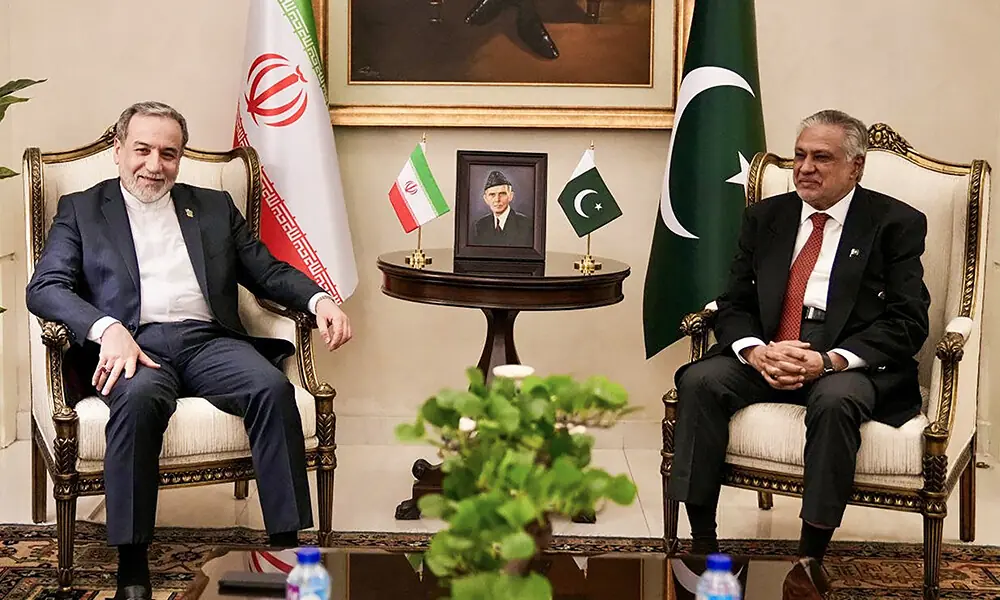
ISLAMABAD/WASHINGTON: Iranian Foreign Minister Abbas Araqchi laid out Iran’s demands and its reservations about US positions on Saturday as Islamabad hosted a new push to end a war that has killed thousands and roiled global markets. Though details of the talks were scant, Araqchi met Pakistani Prime Minister Shehbaz Sharif and other high-ranking officials. The White House had earlier announced that President Donald Trump’s special envoy Steve Witkoff and son-in-law Jared Kushner would travel to the Pakistani capital on Saturday, but Iran has so far ruled out a new round of direct talks. READ MORE: Witkoff and Kushner headed to Pakistan for Iran talks, White House says Washington and Tehran are at an impasse as Iran has largely closed the Strait of Hormuz, which normally carries one-fifth of global oil shipments, while the US blocks Iran’s oil exports. Iran sets out its ‘principled positions’ The conflict is now entering its ninth week, with a ceasefire that began on June 24 extended by Trump this week. The war has pushed energy prices to multi-year highs, stoking inflation and darkening global growth prospects. Araqchi “explained our country’s principled positions regarding the latest developments related to the ceasefire and the complete end of the imposed war against Iran”, said a statement on the minister’s official Telegram account. READ MORE: US negotiators to go to Islamabad, but Iran says no direct talks Asked about Tehran’s reservations about US positions in the talks, an Iranian diplomatic source in Islamabad told Reuters : “Principally, Iranian side will not accept maximalist demands.” US Defense Secretary Pete Hegseth had earlier told reporters that Iran had a chance to make a “good deal”. “Iran knows that they still have an open window to choose wisely,” he said. “All they have to do is abandon a nuclear weapon in meaningful and verifiable ways.” Araqchi arrived in Islamabad on Friday. But an Iranian foreign ministry spokesperson posted on X that Iranian officials did not plan to meet US representatives and that Tehran’s concerns would be conveyed to mediator Pakistan. Trump told Reuters on Friday that Iran planned to make an offer aimed at satisfying US demands but that he did not know what the offer entailed. He declined to say who Washington was negotiating with, “but we’re dealing with the people that are in charge now”. READ MORE: Iranian FM Araghchi meets CDF Munir in Islamabad: report White House press secretary Karoline Leavitt said the US had seen some progress from the Iranian side in recent days and hoped more would come this weekend, while Vice President JD Vance was ready to travel to Pakistan as well. Ceasefires in place, few ships crossing hormuz Days after Trump extended the ceasefire, international flights resumed from Tehran’s Imam Khomeini International Airport on Saturday, Iranian media said. The first passengers had departed for Medina, in Saudi Arabia, Muscat and Istanbul, with operations expected to accelerate in the coming days. “Well, it’s a good feeling. When flights resume, trade is done, and people can do their jobs. It’s a good feeling,” said one passenger at the airport, where passengers were queuing at check-in desks. Iranian airspace has been largely closed since the start of the war. Tens of thousands of flights have been cancelled, rerouted and rescheduled worldwide, shutting much of the Middle East’s airspace because of missile and drone threats. Trump unilaterally extended a two-week ceasefire on Tuesday to allow more time to reconvene the negotiators. Oil prices surged this week, with Brent crude futures soaring 16%, on uncertainty over the fate of the peace talks and as violence flared in the region. Shipping data on Friday showed that five ships had crossed the Strait of Hormuz in the previous 24 hours, compared to around 130 a day before the war launched by the US and Israel on February 28. The ships included an Iranian oil-products tanker but none of the vast crude-carrying supertankers that normally feed global energy markets. Data analytics firm Vortexa said this week it had recorded 35 total transits through the US blockade from April 13 to 22, involving Iran-linked or sanctioned vessels for inbound and outbound journeys. “The enemy, whose objective of crippling Iran’s missile and military capabilities has failed, is now seeking an honorable exit from the quagmire of war,” Iranian media quoted a defence ministry spokesperson as saying. “Iran is today in firm control of the Strait of Hormuz.” On Thursday, Israel and Lebanon extended their ceasefire for three weeks at a White House meeting brokered by Trump, but there was little sign of an end to the fighting in southern Lebanon. Israel invaded its northern neighbour last month to root out Iran’s Hezbollah allies after the militant group fired across the border. Tehran says a ceasefire there is a precondition for talks. Four people were killed in Israeli strikes on southern Lebanon on Saturday, Lebanon’s state news agency reported, after Israel’s military said it had killed six Hezbollah members in the south of Lebanon on Friday. The Israeli military reiterated a warning on Saturday for Lebanese residents not to approach the Litani River area in southern Lebanon as it was still battling Hezbollah, and said it had struck loaded rocket launchers belonging to Hezbollah in three locations overnight.
Go to News Site