


 Forbes India
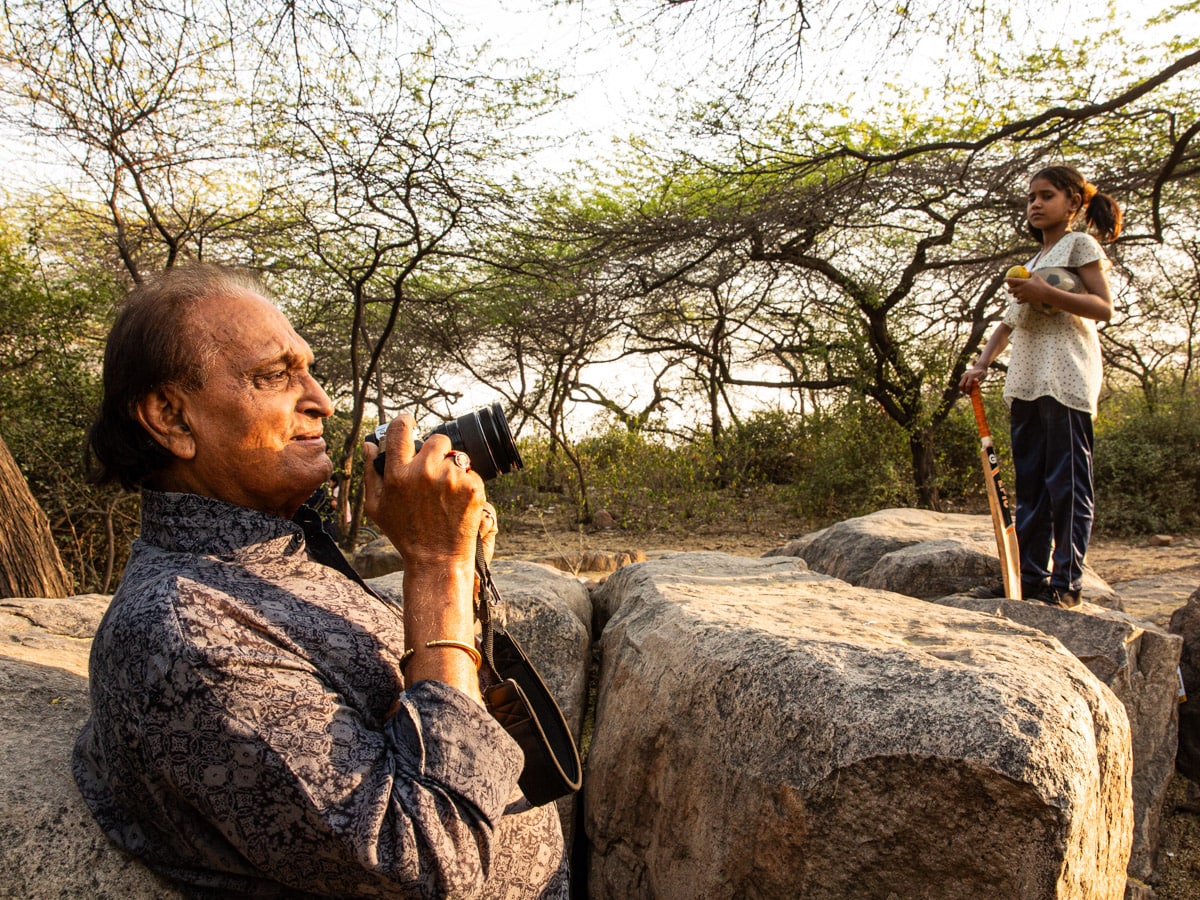
For Raghu Rai, seeing and photographing was an act of ‘darshan’. His prolific photography, over a six-decade career was a testimony to his belief in ‘darshan’, an act of drawing out, from ‘the moment’, a form and meaning of India in all its contrasts—its tenderness and turmoil, its fragility and force. For this to happen, Rai had to, in his own words, “make oneself available mentally, physically, spiritually to the moment”. Which is why a conversation with Rai about photography invariably led to being ushered, frustratingly sometimes, into the ‘great hall of silence’. For the ‘darshan’ he talked about, one had to be initiated first into the mysteries of the silence, and later, the meandering walk.The result of the walk—and the work—through corridors of pain and power earned him global recognition. There was a powerful coverage of the Bangladesh War and the refugee crisis, the Bhopal gas tragedy and the Emergency in India. Then the books of great depth and range that followed—on India, Mother Teresa, Taj Mahal, Satyajit Ray, Delhi, Indira Gandhi, Calcutta, The Dalai Lama & Tibet in Exile, Khajuraho, Trees, The Sikhs, The Great Maestros of Indian music and many more in updated editions that left his fellow photographers gasping at the sheer volume of his oeuvre. According to his Foundation, Rai, who passed away on Sunday aged 83, was at work on his 57th book.Also Read: Faces That’ve Made IndiaHis work began ironically with a photograph he took and got published in The Times, London, of a baby donkey in his village, an animal most associated with the phrase ‘beast of burden’, thrown in jest at photographers for carrying a bagload of equipment.Born in 1942 in Jhang in pre-partition Punjab, Rai studied to be an engineer, but found himself drawn to photography in the 1960s, following his brother who was also a well-known photojournalist. He would join The Statesman as its chief photographer in 1966 and go on to shape India’s socio-political landscape with incisive, sometimes humorous photography. His instinct and talent caught the attention of Henri Cartier-Bresson who came across Rai’s work in the 1970s and nominated him to join Magnum Photos, the photographers’ co-operative in 1977—the first Indian to have the honour. Rai would go on to have a distinguished career as a photo editor and photographer at the Sunday magazine, and at India Today in its formative years in the 1980s, eventually pursuing his own projects and shows, which are numerous to describe. Rai collected many awards and accolades, from the Padma Shri in 1972 to the Academie des Beaux Arts Photography Award–William Klein 2019.Beyond the awards and acclaim, Rai’s ‘darshan’ reveals his empathetic and unflinching feeling—for everyman. His retrospective recently at the Kiran Nadar Museum of Art in a show titled ‘A thousand Lives: Photographs 1965 to 2005’ was a stirring testimony to the song of everyman, a long-drawn raga, built from reflection and stirred emotion that punctured time’s ego.
Go to News Site