


 Daily Finland
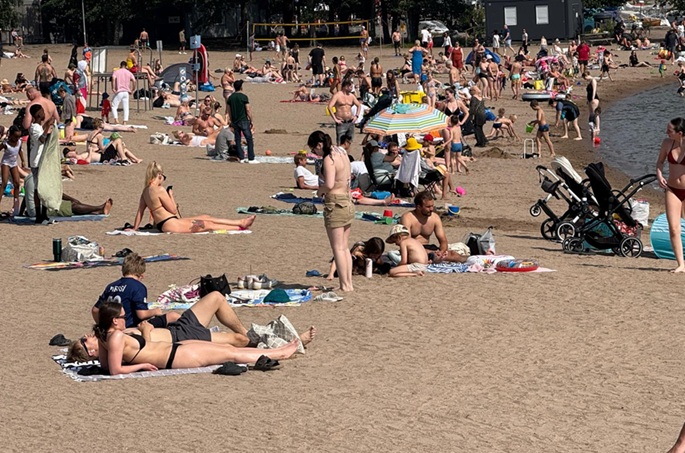
The Finnish Meteorological Institute (FMI) advised the people to protect themselves against excessive Ultra Violate (UV) radiation from the sun when the UV index is three or higher, said FMI in a press release on Wednesday. In Finland, this level UV, is classified as moderate and there is a moderate risk of harm from unprotected sun exposure, will take place from May to September between 10:00 am and 5:00 pm. At this time of the year, the midday sun may cause burns in people with sensitive skin. According to a recent study, young people like sunbathing and tanning, even though they are also concerned about the health hazards of UV radiation and the risk of skin cancer. “Good ways of protecting yourself include seeking shade, wearing clothes with long sleeves and legs, and wearing hats and sunglasses. Exposed skin areas should be protected with a sunscreen that has a protection factor of at least 30,” said Kaisa Lakkala, Senior Scientist of the FMI. Excessive UV radiation increases the risk of developing skin cancer. The effects of radiation accumulate in the skins memory throughout its lifetime, so both burning and prolonged solar exposure should be avoided. People are advised to check the UV radiation forecast in the UV index service on the website of the Finnish Meteorological Institute and in the Local weather mobile app. The value of the observed UV index in seven localities in Finland and in the largest cities in Europe also could be viewed. Young peoples attitudes towards sunbathing and tanning are contradictory, as shown by a recent citizen study conducted by the Cancer Society of Finland and the Radiation and Nuclear Safety Authority (STUK). The majority of Finnish young people aged 16–20 enjoy sunbathing and tanning, even though they are also concerned about the health hazards of UV radiation and the risk of skin cancer. A total of 780 young people responded to the survey at the end of 2025. According to the study, young people mainly obtained their tans from the sun: 81% of respondents spend a lot of time in the sun or sunbathe, and 74% say they get their tan specifically from the sun. Sunbathing has increased, especially among the youngest respondents. “One worrying observation about the results of the survey is that sunburns are common among young people. 70% of the respondents report sunburns at least once in the past year, and nearly one in five have had three or more burns. Based on this information, young people burn their skin considerably more often than the population on average, as in a survey conducted by STUK in 2024, only 19% of respondents reported having sunburns at least once a year,” said Anne Höytö, Senior Specialist of STUK. Although most young people know that UV radiation increases the risk of skin cancer, many feel that their own risk is small. Protection is focused on sunscreen, while clothing and shade are clearly given less attention. The UV index is well known among young people, but they often use it to maximise tanning rather than to help protect themselves. About 86% of respondents know what the UV index is, and 73% say they are monitoring it. Only 27% of young people use the UV index as a guide for protective measures, while 39% monitor the UV index to promote tanning. “Young people often spend a lot of time outdoors, and at the same time exposure to UV radiation can be high. The UV index is intended to help you understand when the skin should be protected from the harmful effects of UV radiation. The glorification of tan combined with the use of the UV index for tanning is a worrying phenomenon. Although beauty ideals are changing in time, the charm of tanning still seems to prevail and sunbathing is still the primary means of acquiring it,” said Heidi Löflund-Kuusela, Manager of Health Promotion of the Cancer Society of Finland. The Cancer Society of Finland and STUK emphasised that the results show a clear need to strengthen communication aimed at young people about the harmful effects of UV radiation and effective means of protection. It is essential to support everyday solutions that reduce excessive exposure to the sun and to strengthen a positive outlook towards ones own skin and skin type without pressures about tanning. According to the most recent cancer statistics, nearly 1,800 new cases of melanoma, over 2,100 cases of squamous cell cancers and over 10,000 cases of basal cell cancer were diagnosed in Finland in 2025. “The incidence of UV-related skin cancers has levelled out compared to the strong growth at the beginning of the millennium. For cases of melanoma, the peak was in 2016, after which the number of annual cases has remained reasonably stable. There are practically no major differences in actual skin cancer mortality between the past few years,” said Taneli Väisänen, Chief Medical Officer of Cancer Foundation Finland. For melanoma, there are differences in cases by place of residence and gender, among other things. Men are at a higher risk of falling ill and also dying of melanoma than women. However, the five-year prognosis for both sexes is high, more than 90%.
Go to News Site