


 Business Recorder
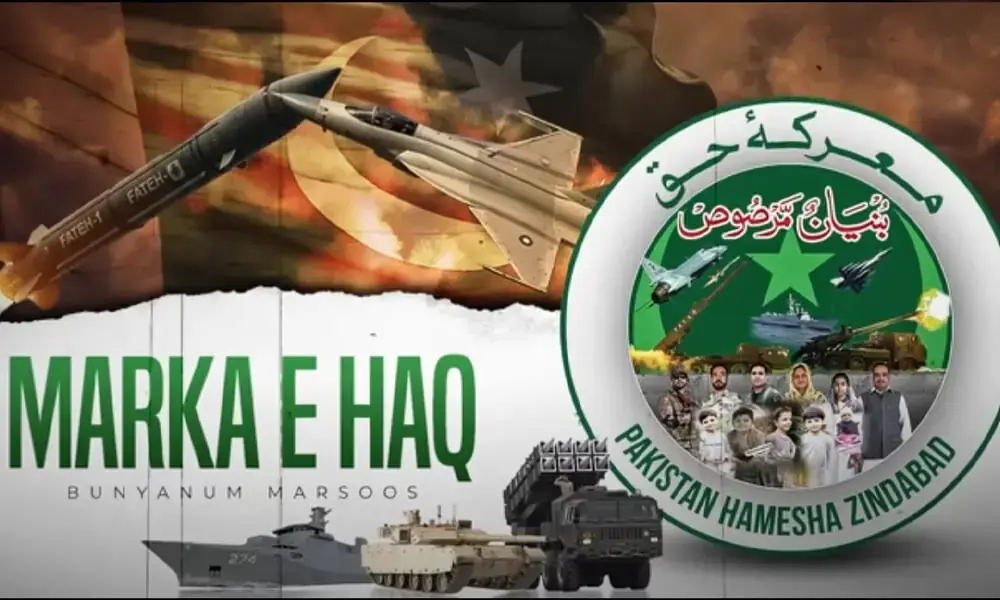
ISLAMABAD: Pakistani military Saturday described Operation Bunyan-un-Marsoos as part of the broader military campaign officially termed “Ma’arka-e-Haq,” targeting hostile military infrastructure and “largest, longest and most complex coordinated offensive response” conducted by Pakistan. Sources said that one year after “Ma’arka-e-Haq,” Pakistan’s military no longer describes the May 2025 confrontation with India as a limited border escalation. Inside strategic circles, the conflict is increasingly being framed as South Asia’s first fully integrated multi-domain military engagement — one that combined airpower, cyber operations, electronic warfare, information dominance, drones, precision-strike systems and strategic deterrence into a synchronized offensive campaign. More importantly, Pakistani military sources now describe the operation as the “largest, longest and most complex coordinated offensive response” conducted by Pakistan in recent history. At the center of Pakistan’s post-conflict narrative lies a claim that officials say permanently altered regional military perceptions: the dismantling of what Islamabad calls the myth of “untouchable Indian air superiority.” Air Vice Marshal Tariq Mahmood Ghazi, during a press briefing, maintained that Pakistan achieved an “8-0” air combat outcome during the confrontation — a figure repeatedly referenced in military briefings and strategic discussions over the past year. According to Pakistani military sources, the aerial losses included four Rafale fighter aircraft, one Su-30, one Mirage 2000, one MiG-29 and one additional expensive multi-role combat platform. Military officials further say that several additional Indian aerial assets sustained extensive operational damage during the conflict, with some allegedly remaining non-operational or beyond meaningful repair afterward. While India has not officially acknowledged many of these claims, the confrontation triggered one of the most intense debates in recent South Asian military history regarding air superiority, electronic warfare vulnerability and the survivability of high-end platforms in future warfare. The crisis began on April 22, 2025, after the Pahalgam incident in Indian Illegally Occupied Jammu and Kashmir, in which 26 people were killed. India blamed Pakistan within minutes, a move Islamabad strongly rejected, arguing that accusations and FIRs emerged before any meaningful investigation could take place. Pakistan maintained that the speed of the accusations raised serious questions regarding the credibility of the narrative itself. Within hours, tensions escalated dramatically across the Line of Control, and the broader region entered one of its most dangerous military standoffs in recent years. For four days, South Asia witnessed a rapid cycle of escalation involving aerial engagements, drone operations, precision strikes, shelling across the LoC, electronic warfare activity and strategic signalling between two nuclear powers. Unlike previous India-Pakistan crises, the conflict involved synchronized operations across air, land, sea, cyber, electronic, cognitive, informational and space domains, reflecting the changing character of modern warfare in South Asia. In response, Pakistan launched Operation Bunyan-un-Marsoos as part of the broader military campaign officially termed “Ma’arka-e-Haq,” targeting hostile military infrastructure through calibrated retaliatory strikes. Military sources later described the operation as Pakistan’s “largest, longest and most complex coordinated offensive response,” involving integrated action by conventional forces and technological warfare components. During a detailed anniversary press briefing marking one year of the confrontation, DG ISPR Lieutenant General Ahmed Sharif Chaudhry repeatedly emphasised that the conflict fundamentally altered regional strategic calculations. According to Pakistan’s military leadership, the confrontation exposed what Islamabad describes as the collapse of India’s long-standing effort to internationally isolate Pakistan through terrorism-related narratives. Military officials argued that despite sustained Indian diplomatic efforts following the Pahalgam incident, the international community largely focused on preventing escalation between two nuclear states rather than fully endorsing New Delhi’s narrative. Pakistan’s military also used the anniversary briefing to frame the confrontation as a case study in next-generation warfare. According to officials, future conflicts will no longer remain confined to traditional battlefields. Pakistan Air Force officials explained how cyber warfare, electronic attack capability, communication disruption, drones, stand-off weapons and precision-strike systems were integrated into one synchronised combat architecture during the conflict. Air Vice Marshal Tariq Mahmood Ghazi described Ma’arka-e-Haq as one of South Asia’s first practical demonstrations of integrated multi-domain warfare. The Pakistan Air Force employed electronic warfare, cyber disruption, data-link denial, communication interference, unmanned systems, killer drones, loitering munitions and long-range precision-strike capabilities simultaneously during the confrontation. One of the most closely watched moments of the conflict, according to military officials, occurred on April 29, when four Indian Rafale aircraft allegedly attempted to move toward operational vectors near Kashmir. Pakistan claims that electronic warfare and cyber operations disrupted the aircrafts’ communication systems, data links and operational coordination, forcing them to abort their mission. On May 10, Pakistan launched a large-scale coordinated offensive campaign using killer drones, hypersonic vectors, long-range stand-off weapons, cyber disruption and precision-strike systems. The operation targeted 16 Indian air bases, BrahMos facilities, command-and-control centers, operational nodes and two S-400 air defense batteries. For Pakistani planners, the significance of Ma’arka-e-Haq lies not simply in tactical outcomes, but in what they describe as the restoration of deterrence against a conventionally larger adversary. The military leadership repeatedly emphasised after the conflict that there remains “no space for war” between nuclear powers. Yet paradoxically, the confrontation also demonstrated how future crises between nuclear states may increasingly occur below the threshold of full-scale war while still involving highly advanced technological escalation. Pakistan’s military now argues that Ma’arka-e-Haq accelerated modernisation across virtually every operational domain. Air Vice Marshal Tariq Mahmood Ghazi also recently announced that around 160 indigenous defense projects are currently under development following lessons learned from the conflict. According to details, these projects include integrated air defense systems, advanced electronic warfare capability, cyber warfare platforms, next-generation unmanned systems, indigenous surveillance architecture, upgraded JF-17 variants, additional J-10C platforms and long-range precision-strike systems. Alongside military losses, civilian casualties — particularly women and children living near the Line of Control — became one of the most painful dimensions of the confrontation. According to data shared by the military, a total of 51 people lost their lives while 199 were injured during four days of Indian attacks and cross-border escalation last year. The military stated that Indian strikes deliberately targeted civilian areas, resulting in the martyrdom of 40 civilians, including seven women and 15 children. Pakistan Armed Forces also lost 11 military personnel during the confrontation, while 78 others were injured. During a two-day visit to Hajira, Azad Jammu Kashmir and surrounding areas along the Line of Control, Business Recorder witnessed damaged homes, military positions and communities still carrying visible scars of the escalation. Residents interviewed near the LoC described a population that has spent decades living under the constant shadow of conflict. Yet according to both civilians and soldiers, the events of May 2025 produced an unusual phenomenon: instead of retreating indoors during shelling, many residents reportedly moved toward Pakistani military positions offering assistance. “We were not afraid,” one local resident recalled while speaking to Business Recorder. Another resident described how civilians approached military check posts asking soldiers what they could do for the country. Captain Afnan, who was deployed in the area during the confrontation, recalled that civilians stood “shoulder-to-shoulder” with soldiers despite active shelling. “They were offering food, assistance, anything they could provide,” he said. According to him, troops eventually had to ask civilians to move away from military positions because the attacks had intensified. That image — civilians voluntarily approaching military posts during active shelling — has since become central to Pakistan’s post-conflict narrative. For Pakistan’s military establishment, it symbolised not only public morale, but also the fusion of civilian and military resolve during crisis. However, the conflict also exposed the vulnerability of civilian populations living near the LoC, where even short periods of escalation can rapidly produce humanitarian consequences. Nowhere was that more visible than in the death of seven-year-old Irtaza Shaheed, whose image became one of the defining civilian symbols of Ma’arka-e-Haq. During the visit to the LoC belt, Business Recorder also visited the home of Irtaza Shaheed near Hajira, where visible shell and splinter damage still marks the house one year after the incident. Military officials insist the area contained no militant infrastructure or military facilities. Captain Dr Noman, among the first responders who entered the house after the shelling, described the scene as emotionally devastating. “This was a completely civilian residential area,” he said. “There were no military positions nearby.” He recalled entering a smoke-filled room and finding the child lying on the bed between his mother and elder brother after a shell splinter entered through the roof. The emotional center of the conflict; however, perhaps lies in the testimony of Lieutenant Colonel Zaheer Abbas, the child’s father, who continued commanding military operations after learning about his son’s death. At the time, he was responsible for a military sector populated by nearly 100,000 civilians while simultaneously coordinating operational responses during active conflict conditions. “It was Allah’s blessing that gave me courage,” he recalled. Strategically, Ma’arka-e-Haq also reinforced an uncomfortable but recurring reality in South Asia: deterrence between nuclear states increasingly functions through controlled escalation, technological signalling and calibrated retaliation rather than prolonged conventional warfare. Cyber operations, electronic warfare, drones, information dominance and rapid precision strikes are now becoming central components of deterrence architecture in the region. Ma’arka-e-Haq has already evolved beyond a four-day military confrontation. It is now increasingly institutionalised as a defining national memory shaped by military modernization, strategic resilience, technological adaptation, civilian sacrifice and national unity. And perhaps that is the conflict’s most lasting consequence, not simply what happened during those four days in May 2025, but how Pakistan is preparing for the wars of the future. Copyright Business Recorder, 2026
Go to News Site