


 GB News
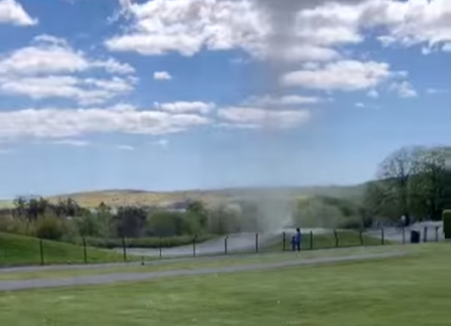
What residents in the Isle of Man initially believed to be a tornado has been debunked by experts who say the spinning weather phenomenon is actually a dust devil. A spinning cloud touched down in the middle of a park in the Isle of Man today. A video of the event shows a spinning column of air circling through Nobles Park in Douglas, on the east of the self-governing island, with spectators watching in awe. The footage was posted on social media, with Manx Life writing on Facebook: "Do we get tornadoes on the Isle of Man? Apparently so..." TRENDING Stories Videos Your Say One man commented he had "seen it all now", while a woman said she would "love to see one". However, tornado experts at Torro, the Tornado and Storm Research Organisation, clarified that what was captured was almost certainly a dust devil rather than a tornado, noting that the shallow cumulus clouds visible in the background are not the type associated with tornado formation. A spokesman from Torro told GB News: "Dust devils typically form on fair weather days under warm, sunny conditions. "They are largely harmless and form from the ground up and are typically not associated with any cloud, which is different to a tornado, which forms from the cloud down and is typically stronger. "We have not had any other reports of dust devils since the end of April, but this is normal, as reports of dust devils tend to increase towards the summer months due to warmer temperatures and also stronger sunshine levels." A dust devil is a short-lived whirlwind that forms when hot air near the ground rises rapidly through cooler air above it. Unlike a tornado, it is not connected to a storm cloud and typically forms on sunny days over dry, flat ground – mostly taking place in rural fields or on construction sites. Most are small, under a metre wide, with winds averaging around 45mph and they typically dissipate within a minute. LATEST DEVELOPMENTS Temperatures to drop through the next week as chilly northerly blast sweeps Britain Archaeologists discover evidence of centuries-old illegal whisky still Soaring petrol and diesel costs prompt new taxi fare hike amid Iran war crisis However, on rare occasions they can grow significantly larger, reaching up to 90 metres in diameter with winds exceeding 60 mph and lasting up to 20 minutes. Dust devils are relatively rare in the UK, but have no specific annual total recorded. However, globally, dust devils have caused significant damage and have even been fatal. In 2003, one lifted the roof off a two-storey building in Maine, US, causing it to collapse. More recently in 2019, a large dust devil in China's Henan province lifted an inflatable play structure into the air, killing two children and injuring twenty others. They have also been linked to around 100 aircraft incidents and are considered a serious hazard by skydivers and paraglider pilots. Meanwhile, around 36 tornadoes are recorded in the UK each year. A tornado is a violently rotating column of air that hangs from a cumuliform cloud, formed when an updraught draws in air from the boundary layer, picking up rotational energy and intensifying it through stretching. Contrary to popular belief, tornadoes can spin both clockwise and anticlockwise in both hemispheres. As tornadoes are relatively small weather systems, they are not meaningfully influenced by the Coriolis force — the effect of Earth's rotation that steers winds around areas of high and low pressure. Anticlockwise rotation is more common in the northern hemisphere. The most powerful tornado ever recorded in the UK struck Welbourn, Lincolnshire, on October 23, 1666, reaching T8–9 on the International Tornado Intensity Scale. Our Standards: The GB News Editorial Charter
Go to News Site