


 Dawn.com
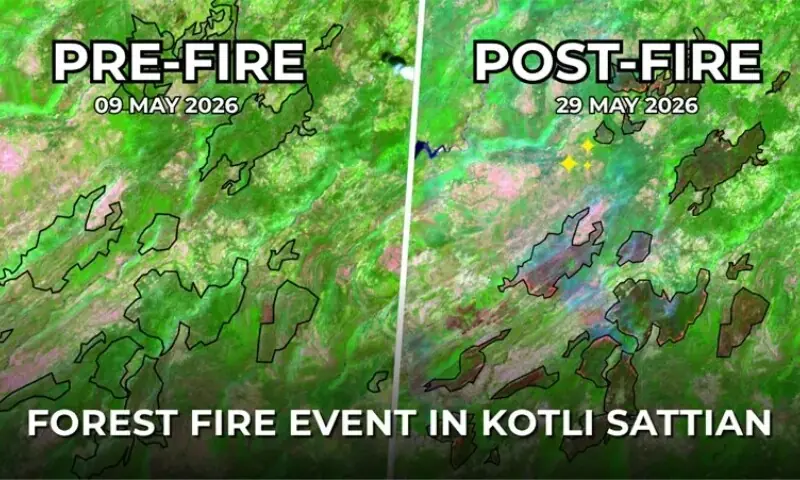
ISLAMABAD: Locals narrate harrowing details of putting out devastating forest fire believed to be human induced, in the ecologically sensitive Kotli Sattian region of Punjab. Caught in the middle of burning towering Pine trees, smoke, and immense heat was Fareha Yousaf and her family. “The ground was so hot that I could feel my feet burn,” Ms Yousaf said. Fareha Yousaf, her husband and two daughters along with their five to six staff members struggled to put out flames that had reached the small fence surrounding their house in Karore village in Kotli Sattian. In the images and videos she shared, her two daughters and staff could be seen picking dry pine needle and shrubs, while others scooped water with plastic mugs from a bucket of water to douse the flames. Fareha Yousaf said there was a burning sensation inside from inhaling smoke. The fires that raged for two days decimated an estimated 3,326.4 hectares of natural forest tree cover across 27 locations in the protected and ecologically rich forest. Forest fire destroyed over 3,000 hectares in Kotli Sattian amid heat wave. According to satellite data released by Suparco on Space4Climate.gov.pk, the analysis comparing imagery from May 9 to May 29 showed extensive damage in Chir pine forests. These forests play a key role in protecting sub-watersheds linked to the Indus and Jhelum river basins. Forest Inspector, Forest Department Punjab, Mohammad Tufail told Dawn that flames reached a towering 100 feet fuelled by gusts of stormy winds. “These are educated people, quite sensitised about risks and consequences of triggering forest fires. It’s lamentable that anyone would act so carelessly,” he said, explaining that in his area of jurisdiction, which was labeled, Forest 99, fires had not raged since 2016-17. He complained about lack of proper firefighting equipment and manpower to overcome forest fires. “We were less than a dozen forest staff members with brooms to put out flames that were engulfing Pine trees and dry shrubs fast,” he said. According to Ministry of Climate Change, forest fire destroys over 3,000 hectares in Kotli Sattian amid heat wave. These forest fire events generally affect the breeding season of the birds, animals, regeneration loss of seedlings and saplings and colonisation of invasive fire tolerant grasses and shrubs. Environmentalists warned that the ecological aftermath extended far beyond the immediate burn scars and that the disaster had severely disrupted the peak breeding season for local birds and wildlife, destroyed vital young seedlings and saplings, and opened the door for invasive, fire-tolerant grasses and shrubs to colonise the damaged terrain. Mohammad Saleem, who is spokesperson for the Ministry of Climate Change and Environmental Coordination, told Dawn that the massive wildfire in Kotli Sattian was not an isolated environmental incident. It was a stark warning of a new climate reality confronting Pakistan. “Forest fires are increasingly becoming the ‘new normal’ across the country as rising temperatures, prolonged dry spells, erratic rainfall patterns and recurrent heat waves create ideal conditions for ignition and rapid fire spread.” He said scientific evidence was unequivocal. “A recent study published in NPJ Climate and Atmospheric Science found that the climate crisis was intensifying extreme heat events across South Asia, with Pakistan emerging as one of the regional hotspots for increasingly synchronised and severe heat waves. These conditions substantially elevate wildfire risks by drying vegetation and reducing soil moisture. Likewise, a study published in Nature Communications has shown that global warming is expanding wildfire-prone areas and lengthening fire seasons worldwide. According to the World Resources Institute, forest fires now burn more than twice as much tree cover globally as they did two decades ago, largely as a consequence of climate change. He said the future of Pakistan’s forests would be determined not only by climate policies and firefighting equipment, but also by the awareness, vigilance and stewardship of the communities living closest to them. “Local communities are the frontline protectors of our forests, and investing in their engagement, training and ownership is among the most effective defences against the growing threat of wildfires,” he added. While local communities and forest department personnel have successfully contained the blaze in several areas, active fires continue to spread across neighbouring slopes, driven by strong, hot winds that threaten further environmental degradation. According to locals, Kotli Sattian is being promoted by the local government as an upcoming tourist destination, with its pristine natural environment, breathtaking sceneries, the Bisa waterfall, and clear areas for camping. Kotli Sattian is ecologically sensitive because the Murree-Kotli Sattian landscape was dominated by Chir pine forest, steep slopes and sub-watersheds linked with the Indus/Jhelum basin. Kotli Sattian forest area under Punjab Forest Department jurisdiction was about 27,653 acres. Fareha Yousaf said she had never faced such a horrific experience where she feared her family would lose their home. “We are all so scared that even though the fire has been put out, the fear is not going away.” Published in Dawn, June 3rd, 2026
Go to News Site