


 The Advocate
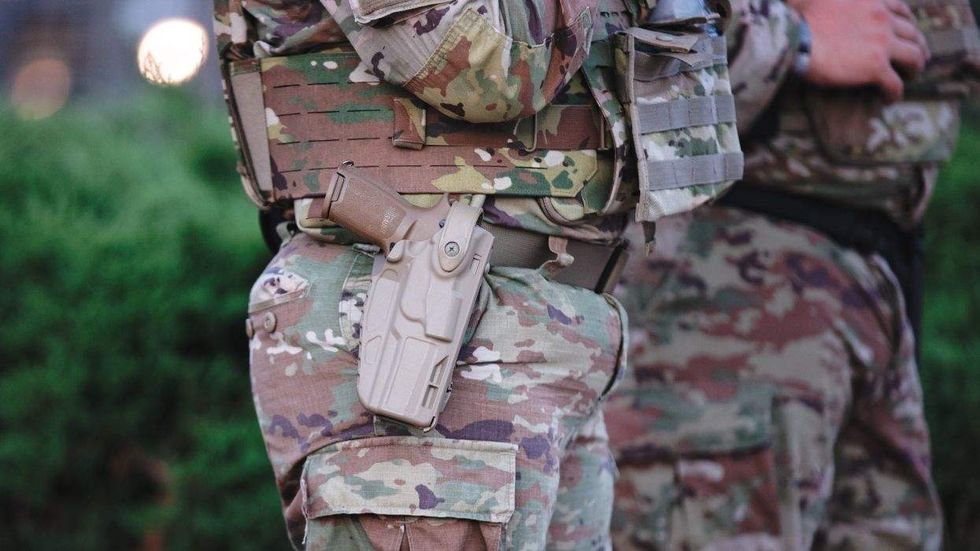
Just days after a federal appeals court revived a major challenge to the military's enlistment ban, the same court has clarified that qualified people living with HIV can once again join the armed forces while the case moves forward. In an order issued Tuesday, the U.S. Court of Appeals for the Fourth Circuit said that when it agreed last month to rehear Wilkins v. Hegseth , it also lifted a stay that had allowed the Pentagon to continue enforcing its ban on enlistment of people living with HIV. The clarification restores a lower court injunction that opened military service to recruits whose condition is well-managed. The development follows The Advocate's reporting last week that the Fourth Circuit had vacated a February panel decision upholding the military's HIV enlistment restrictions and agreed to rehear the case en banc before the full court. At the time, however, uncertainty persisted over whether the panel's stay remained in effect. Tuesday's order resolved that question. Related : Federal appeals court sides with Pentagon against science, reinstating U.S. military’s HIV enlistment ban The practical consequence is immediate: People living with HIV whose virus is suppressed to undetectable levels through medication — meaning they cannot sexually transmit HIV under the scientific principle known as U=U, or undetectable equals untransmittable — may once again enlist in any branch of the U.S. military while the appeal proceeds. "This was unexpected but great news," attorney Peter Perkowski, one of the lawyers representing the plaintiffs on appeal, said in a statement to The Advocate . "On a regular basis, I hear from people with HIV who want to serve their country by joining the military, and that's now again a viable option." The lawsuit was filed in 2022 on behalf of three people denied military opportunities because of their HIV status and Minority Veterans of America, an advocacy organization representing veterans from underrepresented communities. The plaintiffs include Isaiah Wilkins, who left the Army Reserve to attend the U.S. Military Academy Preparatory School but was disenrolled after testing positive for HIV, as well as two pseudonymous plaintiffs who were denied entry or reentry into military service because of the Pentagon's policy. The case has become one of the most significant remaining legal challenges to HIV-specific military restrictions. Courts have repeatedly struck down Pentagon policies targeting service members living with HIV. In Roe v. Austin and Harrison v. Austin , federal judges rejected restrictions that prevented service members with HIV from deploying or obtaining officer commissions, finding that military policies had failed to keep pace with modern medicine. Those victories ultimately led the Defense Department to abandon deployment restrictions for service members whose condition is effectively controlled through treatment. Related : Federal appeals court unexpectedly reverses itself, reviving challenge to Pentagon HIV policy The enlistment ban, however, remained in place. In August 2024, U.S. District Judge Leonie Brinkema of the Eastern District of Virginia struck it down, ruling that the policy was "irrational, arbitrary, and capricious." Brinkema concluded that the ban contributed to stigma surrounding HIV while undermining the military's own recruitment goals. The government appealed, and a three-judge panel of the Fourth Circuit eventually sided with the Defense Department in February. Before issuing that opinion, however, the panel had stayed Brinkema's injunction, allowing the military to continue enforcing the enlistment ban during the appeal. The Advocate has contacted the Department of Defense, but a spokesperson referred questions to the Department of Justice, which did not immediately respond to a request for comment. Last month, the full Fourth Circuit vacated that ruling and agreed to rehear the case. Tuesday's clarification confirmed that the panel's stay had expired along with the panel's opinion. "Frankly, we were surprised the panel imposed this stay in the first place," attorney Scott Schoettes, who argued the appeal, said. "The Defense Department didn't ask the district court to stay the injunction pending appeal — which is generally a prerequisite to an appellate level request — much less ask the three-judge panel to take this highly unusual, preemptive action." The Fourth Circuit has not yet ruled on the merits of the case. The full court in Richmond, Virginia, will hear arguments tentatively in September and eventually determine whether the Pentagon can resume excluding prospective recruits solely because they are living with HIV. Until then, the district court's injunction remains in effect. "We are grateful the full Court reinstated the injunction remedying the Defendants' ongoing unlawful discrimination against people living with HIV," Perkowski said. "And just a little bit hopeful it's a sign of good things yet to come in the Fourth Circuit."
Go to News Site