


 Dawn.com
‘Two-strikes’ rule for promotion deemed unlawful: Islamabad High Court
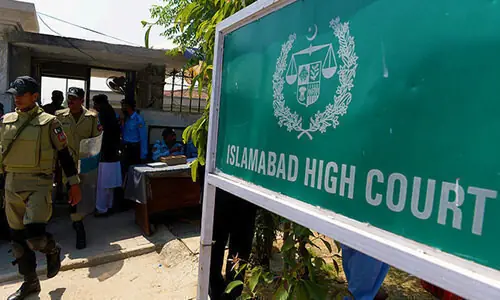
• Justice Minhas declares practice ‘unconstitutional,’ says it imposed a ‘major penalty’ without due process • In the past, senior bureaucrats passed over twice became permanently ineligible for further promotions • Appointment of chairman, ministers to HPSB upheld as being ‘legal’ ISLAMABAD: The Islamabad High Court has invalidated a statutory regulatory order (SRO) barring senior bureaucrats from promotion to BS-22 after two deferrals or rejections, reshaping promotion criteria for Pakistan’s senior civil service. Justice Raja Inaam Ameen Minhas, presiding over a cluster of writ petitions, declared the “ Reconsideration Amendment” (SRO 255(I)/2025) as unconstitutional and “ultra vires” the parent statute, effectively reversing the recommendations of the 29th High Powered Selection Board (HPSB). The legal battle centred on the amendment, notified on March 5, 2025, which stipulated that any officer considered and not recommended for promotion to the top-tier BS-22 grade on two occasions would be permanently ineligible for future consideration. The court found the provision “irrational” and “constitutionally impermissible.” Justice Minhas noted that a deferral could occur for reasons unrelated to an officer’s merit, such as an incomplete service record, being on training, or a temporary lack of vacancies. By treating such procedural delays as equivalent to a finding of unsuitability, the rule imposed a “major penalty” without the due process guaranteed by the Constitution, the judgment said. The ruling addressed seven petitions filed by senior BS-21 officers who were passed over for promotion. The case of M. Aamir Zulfiqar Khan, a veteran of the Police Service of Pakistan, was highlighted by the court as a “stark illustration of irrational decision-making”. Despite having satisfactory performance reports, the board rated him poorly on integrity and leadership without citing specific facts. The court also criticised the practice of keeping Mr Khan as an Officer on Special Duty (OSD) without assigned responsibilities since early 2023. Similarly, Owais Nauman Kundi of the Pakistan Administrative Service had his “satisfactory” service record acknowledged by the board, which simultaneously recorded unexplained adverse assessments of his competence and public service sprit. A major factor in the court’s decision was the violation of natural justice, observing that officers were superseded without being informed of the specific reasons. The judgement emphasised that while bureaucrats do not have an absolute right to promotion, they have an “indefeasible right to be fairly and lawfully considered”. The court also rejected the government’s plea of “confidentiality” for the selection board’s minutes, ruling that such secrecy cannot be used to shield decisions from judicial review. While voiding the “two-strikes” rule, the court upheld the “Chairman Amendment” (SRO 243(I)/2025). It ruled that Muhammad Ishaq Dar could lawfully chair the HPSB as he held the post of Federal Minister for Foreign Affairs, fulfilling the requirement for a “Federal Minister authorised by the Prime Minister”. The inclusion of parliamentarians Bilawal Bhutto Zardari and Khawaja Muhammad Asif for consultation was also declared valid. The court issued several directives, ordering that the petitioners’ cases be reconsidered by the HPSB based on “discernible criteria” and documentary evidence. Any adverse findings must be communicated to the officers within 14 days. The government was also directed to assign M Aamir Zulfiqar Khan a posting appropriate to his rank within 30 days. As part of the relief, the court directed that Sohail Ali Khan, an officer of the Information Group, be considered for a “proforma promotion”. Published in Dawn, March 24th, 2026
Go to News Site