


 Business Recorder
EV envy - US car buyers want the Chinese models they can’t have
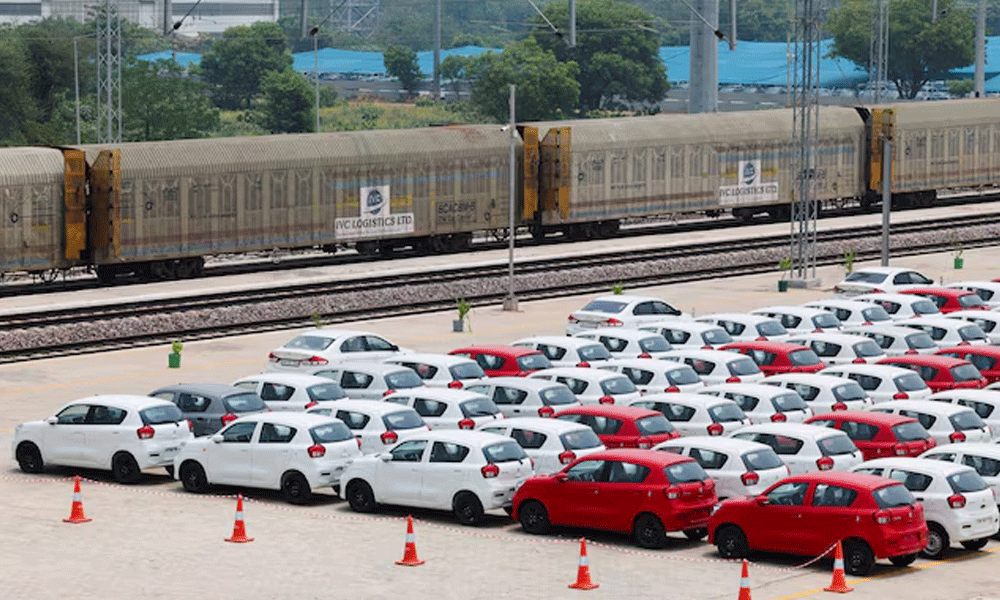
Greetings from London! We’re still only a few weeks into the war with Iran, though to carmakers and consumers alike it already feels longer – and far longer to those living in the firing line in the Gulf. While a few weeks make it hard to gauge the impact on new car sales, a prolonged spike in fuel prices could push more consumers towards electric vehicles. That is less likely in the U.S. where the Trump administration nixed federal tax subsidies for EVs last year than in Europe where EVs are more common and where subsidies are being reintroduced by national governments. Successive U.S. administrations over the last eight years have moved to block Chinese carmakers from selling their EVs in the country. That includes a ban on Chinese hardware and software for connected vehicles that effectively keeps them off U.S. roads. But as Reuters colleague Nora Eckert reports, that doesn’t stop some U.S. car buyers from longing to purchase what they cannot have – a Chinese EV. Xiaomi quarterly profit slumps despite annual EV gains If you’ve driven a Chinese brand EV you’ll know why, as China’s automakers are widely seen as making the best electric cars on the road today. While just 15% of car dealers told Cox Automotive in a recent survey that they support the entry of Chinese auto brands into the U.S. market, nearly half - 49% - of the consumers polled rated Chinese cars as having very good or excellent value. What is more, 40% say they want to see Chinese auto brands in the U.S. market. Faced with a lack of options at home, a car enthusiast interviewed by Reuters is weighing a novel solution: buy a BYD EV in Mexico and then simply drive it across the border. India’s car boom at risk? Demand for cars in India has soared to record levels, but that boom is now threatened by shortages of natural gas for power plants to run car factories. As Reuters colleague Aditi Shah reports, India’s automakers and parts suppliers are bracing for production slowdowns and assembly-line disruptions . Xiaomi says February EV deliveries topped 20,000, down from January Some suppliers to India’s leading carmakers like Maruti Suzuki, Tata Motors and Mahindra are already reporting a shortage of gas to power operations, an early sign that supply chain issues are developing, according to two dozen executives at car companies, parts makers and dealers. India relies heavily on the Middle East for energy supplies, importing 50% of its natural gas needs mostly from Qatar, which has been forced to shut its refinery after a wave of Iranian attacks. While India is working to secure gas from the U.S., Norway and Russia, the government has prioritised supplies for homes over factories. S&P Global Mobility has already begun slashing its India outlook, now forecasting 6.3% growth in light vehicle production for 2026, down from 7.4% projected before the war. Tesla European thaw coming? After more than a year of year-over-year sales declines in Europe, Tesla finally posted an increase in Europe in February. The U.S. EV maker’s sales rose 11.8% last month in Europe, ending a thirteen-month negative streak, industry data showed. But they came in slightly below those of Chinese rival BYD, whose sales more than doubled from the same month of 2025. As Tesla’s European sales can swing wildly from month to month depending on how many ships bring in cars from its factory in Shanghai, it is hard to read too much into one month’s results.And after two years of falling sales in Europe, Tesla is now working from a lower base. But the company will no doubt be pushing to keep this momentum going to avoid a third year of lower car sales. ZYT’s thinking car The CEO of Chinese self-driving car startup ZYT has a bold claim to make about the AI system his company is about to debut: it can outdrive him on the crowded streets of Shenzhen. ZYT, a spin-off from Chinese drone maker DJI, will demonstrate its “mobility foundation model” at Beijing’s car show next month. As Reuters colleagues Kevin Krolicki and Qiaoyi Li report, CEO Shen Shaojie says it’s a much cheaper way to build an autonomous system. Rather than relying on dedicated “modules” to detect cars, pedestrians or traffic lights and training a system based on the geography and traffic patterns of a particular market, ZYT’s model teaches itself to drive, Shen told Reuters. He added that when he took a test drive of the system, his engineers told him “we don’t know what the car is thinking,” a sign of how advanced the latest versions of AI had become. Fast Laps Uber will invest up to $1.25 billion in EV maker Rivian as part of a deal in which the ride-hailing firm will start deploying 10,000 fully autonomous R2 SUVs as robotaxis from 2028. South Korea’s transport ministry recalled 58,000 Hyundai Palisade hybrid sport utility vehicles nationwide over safety concerns following a fatal accident in the U.S. earlier this month. China’s Great Wall Motor is weighing whether to share a factory with another carmaker in South Africa or acquire an existing plant and has held talks with Mercedes-Benz as it considers its options. The U.S. National Highway Traffic Safety Administration has escalated its probe into 3.2 million Tesla vehicles with Full Self-Driving driver-assistance over concerns the system may fail to detect or warn drivers in poor visibility. Italian sports carmaker Lamborghini posted a lower 2025 profit despite record revenue because of U.S. tariffs, currency moves and charges related to scrapping plans for its first EV. BMW’s sales chief Jochen Goller said that prices are stabilising in China after a lengthy EV price war in the world’s largest car market. Think your friend or colleague should know about us? Forward this newsletter to them. .
Go to News Site