


 The Advocate
Campus is not a closet: Why removing Pride flags from Boston University is not 'neutral'
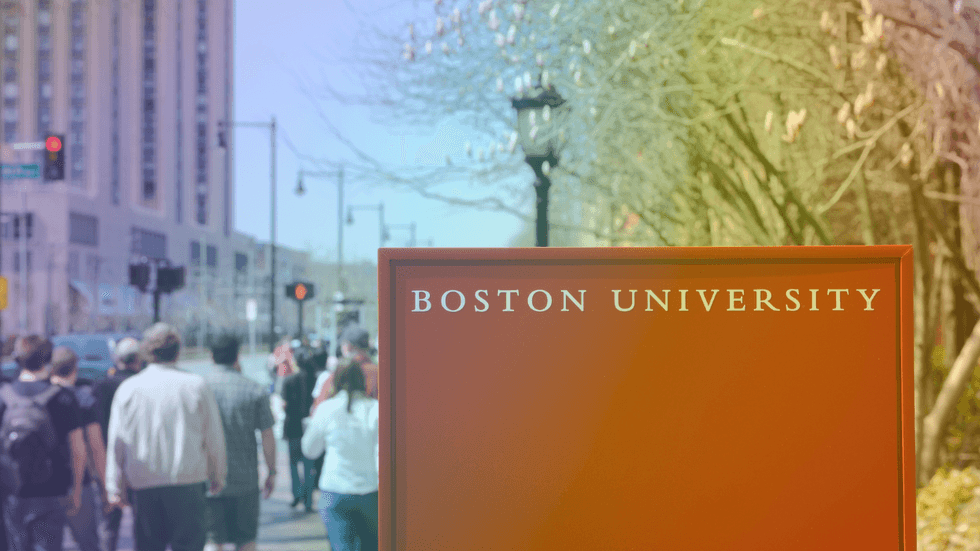
At a recent town-hall event , Boston University President Melissa Gilliam declared, “I want to be very clear that we have unequivocal support for our LGBTQIA plus community.” This statement responded to campus-wide outrage over the ongoing removal of Pride flags from street-facing windows in faculty offices and other public spaces. The removal of these flags is not political, she insisted, but simply reflects BU’s “content-neutral” signage policy . In an era of corporate rainbow-washing , one could argue that there is hardly a more “content-neutral” emblem than the Pride flag. Its originally nuanced symbolism has been sanitized and sold on cheap products made by companies that also donate millions to anti-LGBTQIA politicians and causes . For this reason, BU’s stance on Pride flags might seem insignificant. Even if they change course, that reversal could be interpreted as nothing more than performative allyship. Yet as a queer woman who is a former student and current faculty member at BU, I argue that the Pride flag still plays a crucial role at universities and other educational spaces. In addition to threatening free speech , BU’s repeated efforts to remove it, far from being “neutral,” send a painful message – that the mere act of acknowledging LGBTQIA people exist on our campus is somehow controversial. The first place I remember seeing Pride flags displayed widely was my own undergraduate campus. As a first-year student at Wellesley College, these markers on locations like my Resident Director’s door were a small but significant sign that I was entering a space where I could feel safe. I started college the same year that Massachusetts legalized marriage equality, but many other states , along with the federal government, still actively curtailed LGBTQIA rights. My parents’ best friend and his partner were among the first same-sex couples in Massachusetts to marry, so I knew my family would support me when I came out. But unconditional acceptance was hardly guaranteed in the larger world, and some of my peers could not count on it even from their loved ones. When I took a course on queer literature, it appeared on my transcript as “New Literatures I” so that students would not face discrimination from future employers, regardless of how they identified. I didn’t want my transcript – or my identity – to be censored or politicized, but in the climate I came of age in, I didn’t get to choose whether others saw them as neutral. The spaces adorned with Pride flags on campus thus became vital havens to me and other LGBTQIA students. They announced that there were people within who could commiserate, advocate, and strategize with us as we prepared for life beyond college. I don’t remember seeing many Pride flags as a doctoral student at BU. It’s possible I didn’t notice them, but it was also widely documented that BU was behind the times in supporting its LGBTQIA community members before the recent creation of its student resource center and center for faculty and staff . As a graduate teaching fellow, I initially chose not to share my queerness with students, worried I might alienate some – or, worse, be accused of indoctrinating them. But as I reflected on how impactful it had been to know openly queer faculty and staff when I was an undergraduate, I decided that the benefits of not treating my classroom as a closet outweighed the risks. I have been a faculty member at BU for close to a decade now. While it saddens me to witness my students entering adulthood in an era of renewed political attacks against LGBTQIA people , it also emboldens me to be more open than ever about the pride and joy I feel in my queerness. At the start of each semester, I ask students to present a slide with five personal facts as a community-building exercise. On my own slide, I share that my hobbies include knitting and boxing, and that my favorite color is purple. I also include a photo of my partner and me exchanging our wedding vows in front of a rainbow collage at the Eric Carle Museum of Picture Book Art. When students come to my office, they see a postcard of Louisa May Alcott’s writing desk and my Edgar Allan Poe action figure alongside numerous Pride stickers – including several distributed by BU. I don’t have a Pride flag in my office window, which faces an alleyway. If I did hang one up, I wonder if BU would object as strongly as it does when colleagues place them in windows facing the central campus artery of Commonwealth Avenue. Being a visibly queer educator and explicitly supportive of LGBTQIA students is a sound pedagogical choice. It not only creates safety for these students but also signals to everyone that they can be honest about their own identities. This openness creates a classroom ethos where students can ask questions, make mistakes, receive constructive feedback, express themselves without fear, and form genuine connections with each other. This pedagogical practice reflects my commitment to BU’s own general education requirements . I teach first-year writing and research seminars , in which I am charged to train students to become “responsible writers” who “take ownership of their message and the means of communicating it, and hold their writing to high standards of truth, accuracy, validity, and humaneness.” How could I accomplish this university-mandated goal while hiding my own identity, or encouraging students to mask their own? If BU really wants students to learn these crucial lessons about the power of words, university leadership would do well to take ownership of their own declaration of “unequivocal support” for the LGBTQIA community. They should hold themselves to the same standards of truth and humaneness they espouse, not only by ceasing their efforts to remove Pride flags but by taking more consequential steps to support us. In the meantime, many of us in BU’s classrooms and offices will continue to show up for all our students, ensuring they receive an excellent education while feeling seen in their full humanity – with or without a Pride flag hanging nearby. Heather Barrett, Ph.D., is a senior lecturer in the College of Arts & Sciences Writing Program at Boston University, where she teaches first-year writing and research seminars. Opinion is dedicated to featuring a wide range of inspiring personal stories and impactful opinions from the LGBTQ+ community and its allies. Visit Advocate.com/submit to learn more about submission guidelines. We welcome your thoughts and feedback on any of our stories. Email us at voices@equalpride.com . Views expressed in Voices stories are those of the guest writers, columnists, and editors, and do not directly represent the views of The Advocate or our parent company, equalpride.
Go to News Site